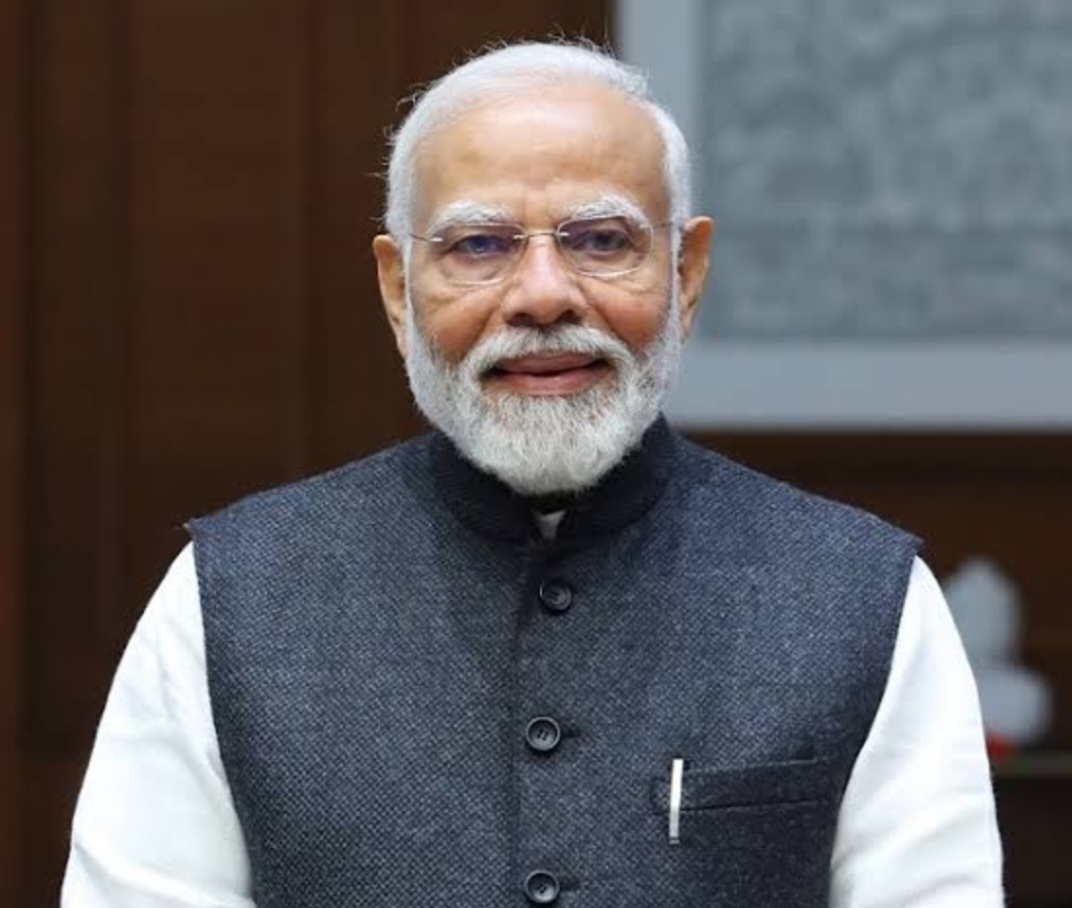
Bengaluru : Prime Minister Narendra Modi will visit Karnataka on Friday. During his visit, he will inaugurate, dedicate to the nation, and lay the foundation stones for various development projects worth over Rs 15,600 crore in Bengaluru and Mysuru. These projects encompass sectors such as urban transport, power transmission, renewable energy, petroleum infrastructure, waste management, and railways.
At approximately 10:45 AM, the Prime Minister will attend the golden jubilee celebrations at Prashanti Kutiram in Bengaluru. On this occasion, he will lay the foundation stone for the golden jubilee administrative building and inaugurate an off-campus centre of the Swami Vivekananda Yoga Anusandhana Samsthana (S-VYASA) in Thiruvananthapuram, Kerala. He will also address the gathering. Established in 1975, Prashanti Kutiram was founded with the objective of integrating modern science with India’s spiritual traditions. The Swami Vivekananda Yoga Anusandhana Samsthana, located there, was granted the status of a ‘deemed-to-be-university’ in 2002 and is actively engaged in the field of yoga education and research.
The event will also mark the birth centenary of Hongasandra Venkataramaiah Seshadri—a thinker, author, and organizer born in Bengaluru—who served as the ‘Sarkaryavah’ (General Secretary) of the Rashtriya Swayamsevak Sangh (RSS) from 1987 to 2000. Around 12:45 PM, the Prime Minister will travel by metro from Tavarekere to the Indian Institute of Science (IISc) metro station. During this journey, he will inaugurate the Pink Line of the Bengaluru Metro, spanning from Kalena Agrahara to Tavarekere. Developed at a cost of approximately Rs 3,470 crore, this section will strengthen the city’s public transport system, save time for commuters, and help alleviate traffic congestion. Thereafter, at around 1:15 PM, the Prime Minister will inaugurate, dedicate to the nation, and lay the foundation stones for development projects worth over ₹15,600 crore in Bengaluru. He will inaugurate a power transmission scheme for the Koppal-II and Gadag-II renewable energy zones, developed at a cost of approximately ₹4,450 crore. This will facilitate the evacuation of about 2 GW of renewable energy from these zones into the power grid.
Additionally, a transmission scheme for the Bidar solar energy zone, developed at a cost of about ₹1,370 crore, will also be inaugurated. This includes the establishment of the Bidar pooling station, which will enable the transmission of 2.5 GW of solar energy from the region. The Prime Minister will lay the foundation stone for a power transmission scheme worth over ₹3,450 crore, connecting the Davanagere, Chitradurga, and Ballari renewable energy zones. Furthermore, he will lay the foundation stone for a project to strengthen the power transmission system—at a cost of over ₹1,100 crore—to integrate additional renewable energy capacity in Davanagere and Ballari.
In Mangaluru, the Prime Minister will dedicate to the nation the country’s largest underground LPG storage facility, built at a cost of over ₹850 crore. It has a storage capacity of 80,000 metric tonnes. The project also includes a 9.4-kilometer-long LPG pipeline from the New Mangaluru Port to the main terminal, which will strengthen the storage and transportation infrastructure for cooking gas. Additionally, the Devangonthi marketing terminal of Mangalore Refinery and Petrochemicals Limited (MRPL), located near Bengaluru, will also be dedicated to the nation. Built at a cost of ₹330 crore, this facility will enhance the storage and distribution of petroleum products.
The Prime Minister will also lay the foundation stone for GAIL’s Compressed Biogas (CBG) plant in Harlakunte, Bengaluru. This plant will process approximately 300 tonnes of municipal solid waste daily to produce 12.6 tonnes of Compressed Biogas (CBG). This will promote scientific waste management and help reduce reliance on conventional fuels. The Prime Minister will inaugurate four railway stations—Chamarajanagar, Chikkamagaluru, Sakleshpur, and Subrahmanya Road—redeveloped under the ‘Amrit Bharat Station Scheme’. These stations now offer improved passenger amenities and have been developed as hubs to boost local commercial activities and tourism.

The Prime Minister will dedicate to the nation the 45-kilometre-long doubled rail section between Bagalkot and Vandal, part of the Gadag-Hotgi doubling project. This will facilitate smoother operations for both passenger and freight trains, while also supporting local trade and the supply of coal to the Kudgi NTPC plant. He will also dedicate to the nation the electrification of the 55-kilometre-long Sakleshpur–Subrahmanya Road Ghat section. With this completion, the entire Bengaluru–Mangaluru rail route will be fully electrified.
The Prime Minister will flag off the Bengaluru–Mangaluru–Madgaon Vande Bharat Express. This train will provide fast rail connectivity between Bengaluru, coastal Karnataka, and Goa. Passing through Hassan, Sakleshpur, Mangaluru, Udupi, Murudeshwar, Gokarna, and Karwar, the train will reach Madgaon in Goa. This will offer passengers enhanced rail connectivity and provide a boost to regional tourism.
Following the events in Bengaluru, the Prime Minister will travel to Mysuru. At approximately 3:30 PM, he will participate in a plantation drive at ‘Bharat Van’, organized under the ‘Ek Ped Maa Ke Naam’ (A Tree in the Name of Mother) campaign. Bharat Van is being developed using the Japanese ‘Miyawaki’ method. Spanning an area of 17.63 acres, the project involves the planting of over two lakh saplings of native species.