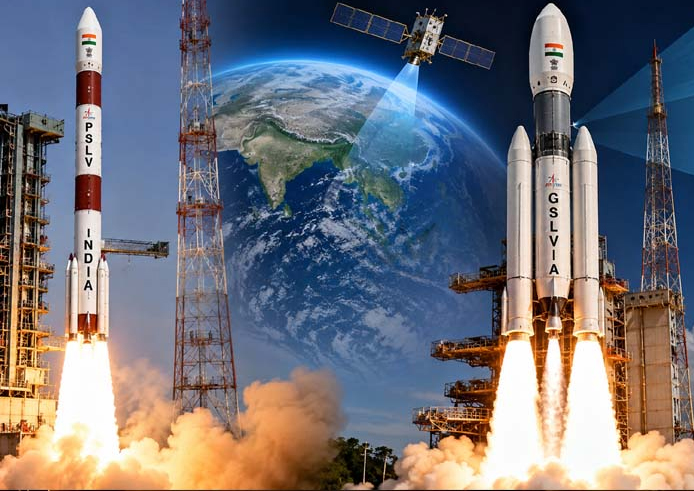
India News : The Indian Space Research Organisation (ISRO) successfully launched the EOS-5 Earth observation satellite aboard the GSLV-F17 rocket. The rocket lifted off from the Satish Dhawan Space Centre at 2:55 am and placed the satellite into its designated sub-geosynchronous transfer orbit.
EOS-5 has been developed for Earth observation and is capable of continuously monitoring and capturing images of large areas from an altitude of around 36,000 kilometres.
The satellite is expected to support weather monitoring, early detection of natural disasters, agriculture and environmental observation, as well as monitoring of strategic areas.
ISRO Chief Hails Mission Success
According to media reports, ISRO Chairman Dr V. Narayanan expressed happiness over the success of the mission and said the GSLV-F17 accurately placed the advanced Earth observation satellite into its designated orbit.
Officials associated with the mission said the launch marked the 19th mission of the GSLV programme.
The GSLV-F17 rocket stands 51.7 metres tall and weighed 420.5 tonnes at the time of launch.
How PSLV and GSLV Differ
India’s space programme primarily uses launch vehicles such as the Polar Satellite Launch Vehicle (PSLV) and Geosynchronous Satellite Launch Vehicle (GSLV). Both are designed to place satellites in space, but they differ in capability, design and the types of orbits they serve.
PSLV is regarded as ISRO’s reliable workhorse and is primarily used to place satellites in low-Earth and polar orbits. It is particularly useful for missions involving Earth imaging, mapping, weather observation and remote sensing.

PSLV is a four-stage rocket that uses both solid and liquid propellants. Its fourth stage is powered by liquid fuel and helps place satellites accurately into their designated orbit.
Its reliability and comparatively lower cost have made it widely used for launching small and medium-sized satellites.
GSLV Designed for Heavier Payloads
The Geosynchronous Satellite Launch Vehicle, or GSLV, is more powerful than the PSLV. It has been developed to carry heavier satellites into higher orbits, particularly geosynchronous transfer orbit.
GSLV has three stages and uses a cryogenic engine in its upper stage. The engine uses extremely cold propellants, including liquid hydrogen and liquid oxygen, providing additional thrust for carrying heavier payloads into higher orbits.
While GSLV technology is more complex and expensive, its ability to carry heavier payloads makes it important for large communication satellites and other missions requiring higher orbits.
The launch of EOS-5 aboard GSLV-F17 is an example of this capability.