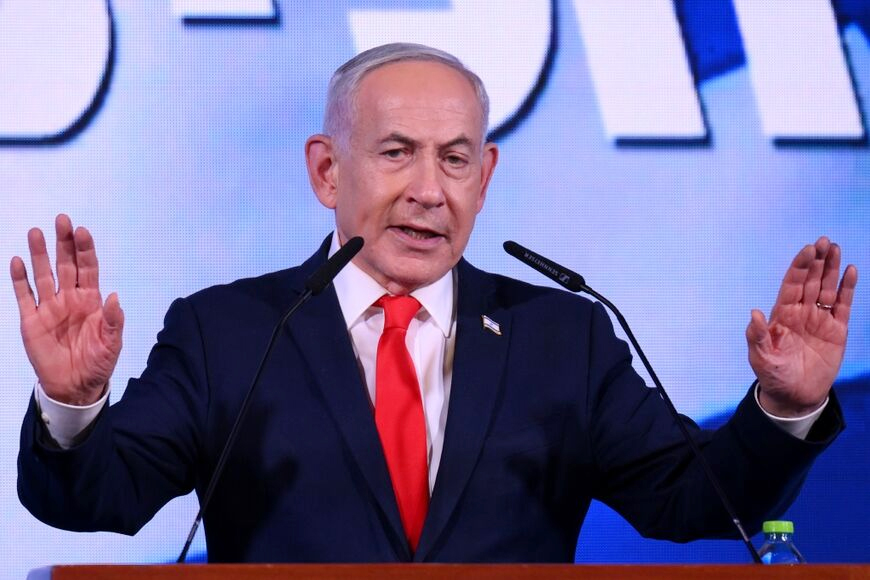
Jerusalem: Following the significant setback faced by Donald Trump’s Republican Party in the U.S. midterm elections, Prime Minister Benjamin Netanyahu now appears to be facing mounting political difficulties in Israel. In the efforts to form a government following the Israeli general election held on October 27, opposition leader Gadi Eizenkot has secured the support of 67 lawmakers, while 46 lawmakers have expressed their support for Netanyahu.
Israeli President Isaac Herzog shared this information on November 5, following consultations with various political parties. However, he clarified that the ability to form a stable government cannot be determined solely based on the recommendations of lawmakers. The President is set to make a decision on this matter on Sunday.
46 Lawmakers Back Netanyahu, 67 Support Eizenkot
Israel’s parliament, the Knesset, consists of 120 members. President Herzog met with representatives from all the elected political parties to ascertain their preferences regarding the formation of a government.
During this process, 67 lawmakers recommended Gadi Eizenkot for the position of Prime Minister, while 46 lawmakers supported the incumbent, Benjamin Netanyahu.
Nevertheless, Eizenkot also faces a significant challenge in forming a government. Given the internal divisions among political parties—and the refusal of some parties to join a government with others—securing a parliamentary majority will not be an easy task.
President Herzog to Make a Decision on Sunday
President Isaac Herzog has stated that he will decide on Sunday which lawmaker to task with forming a government. To this end, he will hold separate discussions with the leaders of certain political parties.
Under Israel’s political system, the President grants the opportunity to form a government to the lawmaker deemed most likely to successfully build a coalition and secure a majority in parliament. The designated candidate is initially granted 28 days to form a government. This period can be extended by an additional 14 days, if necessary.

A major setback for Trump’s party in the US as well
Amidst the political challenges faced by Netanyahu in Israel, President Donald Trump’s Republican Party has also suffered significant losses in the US midterm elections. According to American media reports, the Democratic Party has secured a majority in both the House of Representatives and the Senate.
This could make it challenging for the Trump administration to pass legislative measures or advance its policies over the next two years. However, the US elections and the government-formation process in Israel are distinct political developments.
Netanyahu faces the challenge of preserving his coalition
In Israel’s October 27 elections, Netanyahu’s Likud party emerged as the largest party, winning 27 seats. Despite this, the political bloc supporting him failed to secure a parliamentary majority.
Meanwhile, the opposition—led by Gadi Eizenkot—would also need to build a consensus among various parties to form a government. In this context, the decision to be announced by the President on Sunday could play a crucial role in determining the future direction of Israeli politics.