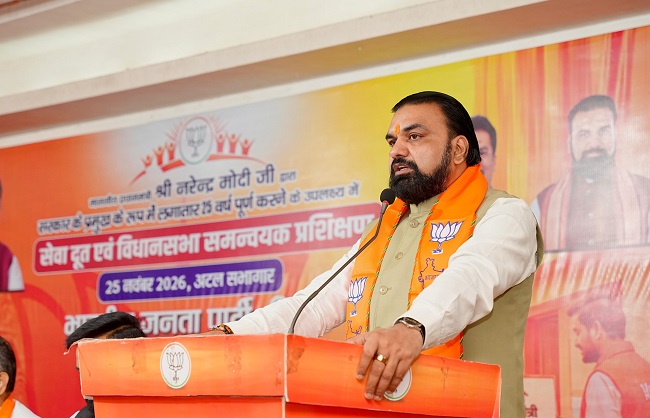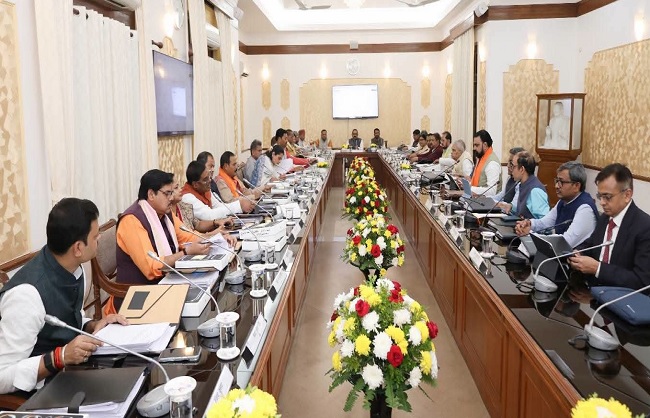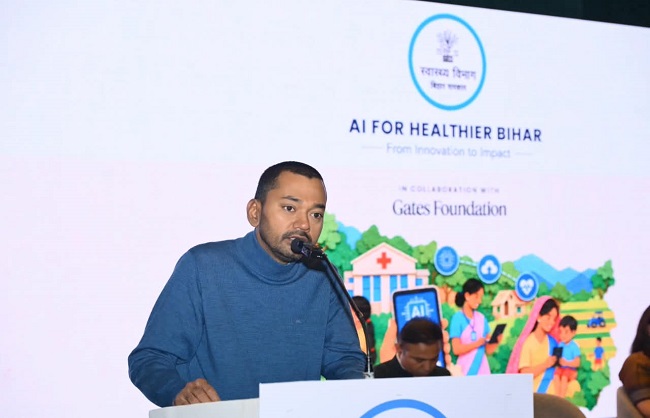
Patna: The state government is placing a strong emphasis on the use of Artificial Intelligence (AI). As part of this initiative, a one-day workshop titled “AI for a Healthier Bihar: From Invention to Impact” was organized by the Government of Bihar, in collaboration with the Gates Foundation, at the Hotel Taj City Centre in Patna. During the event, Health Minister Nishant shared a detailed action plan and his priorities for integrating AI across various sectors of healthcare services.
Health Minister Nishant stated that the government’s objective is not merely to construct hospitals, but to integrate modern technology into the healthcare services provided within them. AI will be utilized across a range of areas—from the availability and supply of medicines to diagnostic equipment, the presence of doctors, telemedicine, hospital bed management, and ambulance services. This will help ensure that even poor patients, particularly those living in rural areas, have timely access to diagnostic tests, consultations with specialist doctors, and improved treatment.
The Health Minister noted that AI could play a pivotal role in enhancing the quality of healthcare services, addressing the shortage of doctors, ensuring that specialist medical expertise reaches rural areas, and improving the monitoring of government healthcare institutions. The government’s goal is to ensure that a poor individual living in a rural part of Bihar has access to the same quality of healthcare as those in urban areas. The time has now come to integrate AI into the critical diagnostic equipment used by the health department.
AI can be leveraged for the analysis of X-ray reports, as well as for modern diagnostic modalities like CT scans, MRIs, and ultrasounds. Providing an example, he explained that if a patient undergoes an X-ray in a rural area, AI technology could assist in the early detection of potential signs of illness. This would facilitate the identification of early symptoms of serious conditions—such as tuberculosis or cancer—enabling timely follow-up testing and the commencement of treatment.
Minister Nishant highlighted that the availability of specialist doctors in the rural regions of Bihar remains a significant challenge. For economically disadvantaged families, traveling to large cities to seek treatment from specialist doctors is often difficult. In such situations, integrating AI with telemedicine can enable patients in rural areas to consult directly with medical specialists.
The Health Minister also placed special emphasis on digitizing the availability of hospital beds.

He stated that the real-time status of available beds in general wards, ICUs, high-dependency units, and other critical care units should be accessible online to patients and their families. He mentioned that he had discussed this with the Director of IGIMS a few days ago, requesting the development of a technical system that provides real-time information on occupied and vacant hospital beds.
He added that the Bihar Health Department is working on introducing ‘smart ambulances’ equipped with digital ECG machines, as well as facilities for monitoring pulse, blood pressure, and oxygen levels. Furthermore, these ambulances will feature GPS-based live tracking, digital connectivity with hospitals, AI-driven analysis of a patient’s condition, and the capability for video consultations with medical specialists.
Nishant noted that these smart ambulances should also be linked to trauma centers and super-specialty hospitals. He explained that upon receiving notification of an accident, an ambulance is dispatched via helplines such as 102, 104, 112, or 1033. Paramedical staff then assess the patient’s vital signs, including blood pressure, oxygen saturation, and pulse. He suggested that by integrating this data into an AI system, it would be possible to conduct an initial assessment of the patient’s condition and identify potential risks.