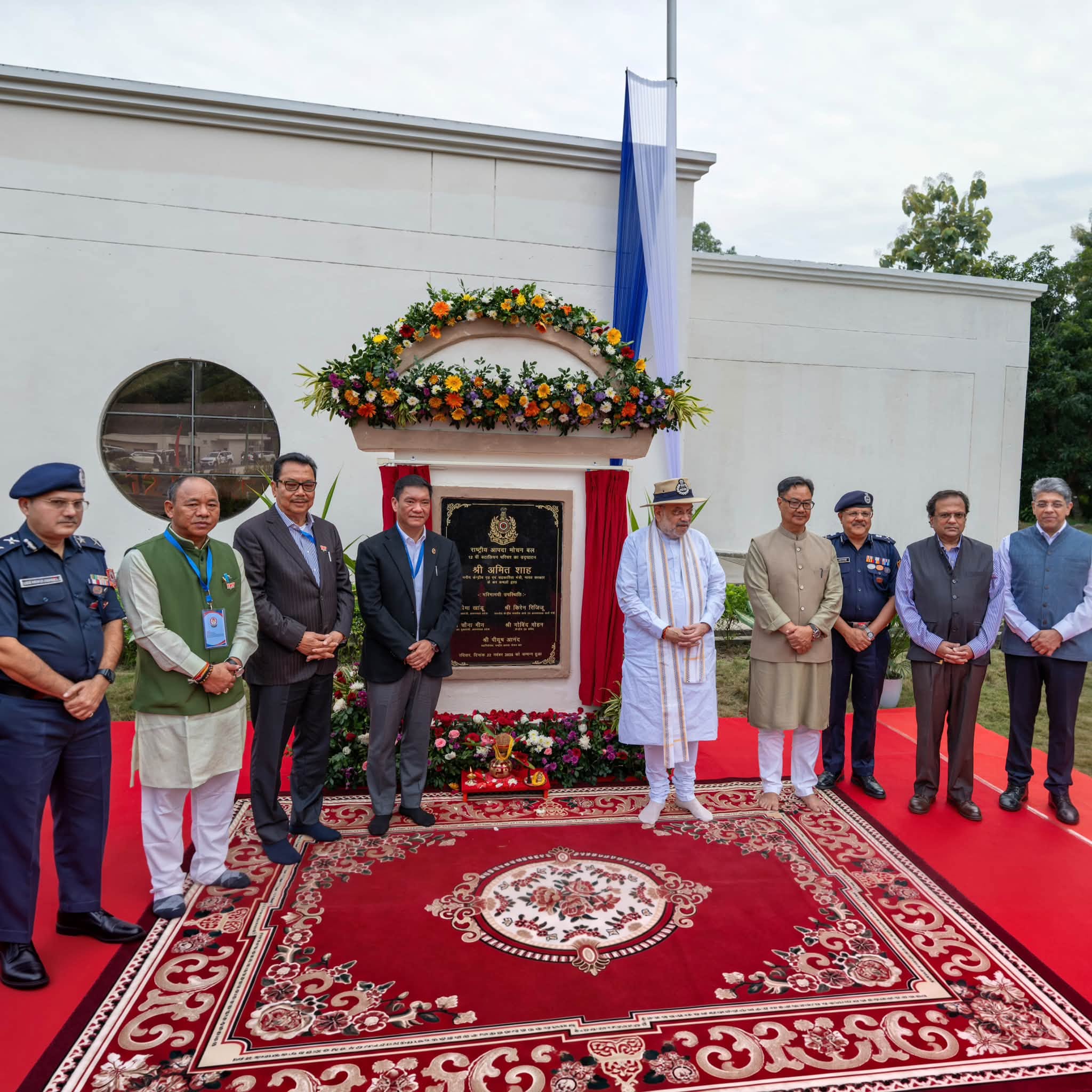
Itanagar: During his three-day visit, Union Home Minister Amit Shah formally inaugurated the newly constructed permanent headquarters building of the 12th Battalion of the National Disaster Response Force (NDRF) in Hollongi, located in the Papum Pare district of Arunachal Pradesh. The establishment of this modern headquarters will strengthen capabilities in disaster management, relief and rescue operations, and rapid response during emergencies across the Northeastern region. Given that the Northeast is highly vulnerable to earthquakes, the complex has been constructed in accordance with specific technical standards tailored to these conditions.
Addressing the gathering during the inauguration ceremony, Amit Shah noted that it took eight years to complete the construction of this headquarters. The foundation stone was laid by Union Minister Kiren Rijiju during the tenure of the BJP-led government. With its completion, the 12th Battalion of the NDRF now has access to a permanent and modern infrastructure.
The Union Home Minister emphasized that the Northeastern region is extremely sensitive to earthquakes, making it essential to have robust infrastructure for disaster management institutions. The establishment of the permanent headquarters for the 12th Battalion of the NDRF in Hollongi will ensure better support during emergencies—not only for Arunachal Pradesh but for the entire Northeastern region. For years, NDRF personnel have been serving the people of this region, playing a crucial role in relief and rescue operations during various disasters.
The NDRF headquarters in Hollongi has been built with careful consideration of the region’s unique geographical and natural conditions. The structure is designed to meet safety and disaster management requirements in an area prone to seismic activity. Equipped with modern facilities, the complex will serve as a hub for personnel training, physical conditioning, and administrative operations. Several significant facilities have been developed within the headquarters complex. These include an Olympic-sized swimming pool, training grounds, sports fields, and Type-III residential quarters for officers and staff. These amenities will provide NDRF personnel with improved training and residential arrangements.
Highlighting the Olympic-sized swimming pool, Amit Shah noted that this facility would not be restricted solely to NDRF personnel; athletes preparing for Olympic or national-level competitions will also have the opportunity to train there. He expressed hope that this swimming pool would prove instrumental in nurturing sporting talent from the Northeastern region and providing athletes with superior training facilities.
In his address, the Union Home Minister stated that the Central Government is placing special emphasis on modern technology and enhanced preparedness in the field of disaster management. Strengthening early warning systems is crucial for minimizing the loss of life and property during disasters. He remarked that the NDRF and other emergency response teams across the country are operating with the aid of modern technology, rigorous training, and improved coordination. Their objective is to reach those affected by natural disasters or other emergencies in the shortest possible time and ensure their safe rescue.

He further noted that India’s disaster response teams are not only conducting relief and rescue operations within various parts of the country but are also extending assistance to other nations when the need arises. This is strengthening India’s capabilities in disaster management and bolstering its role on the international stage.
Previously, the 12th Battalion of the NDRF operated from a temporary headquarters located at Emchi in Doimukh, Arunachal Pradesh. Following the completion of the permanent headquarters building in Holongi, the unit has been relocated to this new complex. The new headquarters will provide the battalion with better administrative, training, and operational facilities. Furthermore, it will enhance the effectiveness of deploying and coordinating relief and rescue teams in the event of disasters across various parts of the Northeast. Given the geographical conditions of Arunachal Pradesh—characterized by its hilly terrain, susceptibility to earthquakes, and vulnerability to natural disasters—this headquarters holds strategic importance. The establishment of a permanent campus will help further strengthen the NDRF’s preparedness and its regional response capabilities.
Present on the occasion were Arunachal Pradesh Chief Minister Pema Khandu, Union Minister Kiren Rijiju, Deputy Chief Minister Chowna Mein, Members of Parliament Tapir Gao and Tai Tagak, State Home Minister Mama Natung, as well as members of the state cabinet, legislators, and senior government officials.