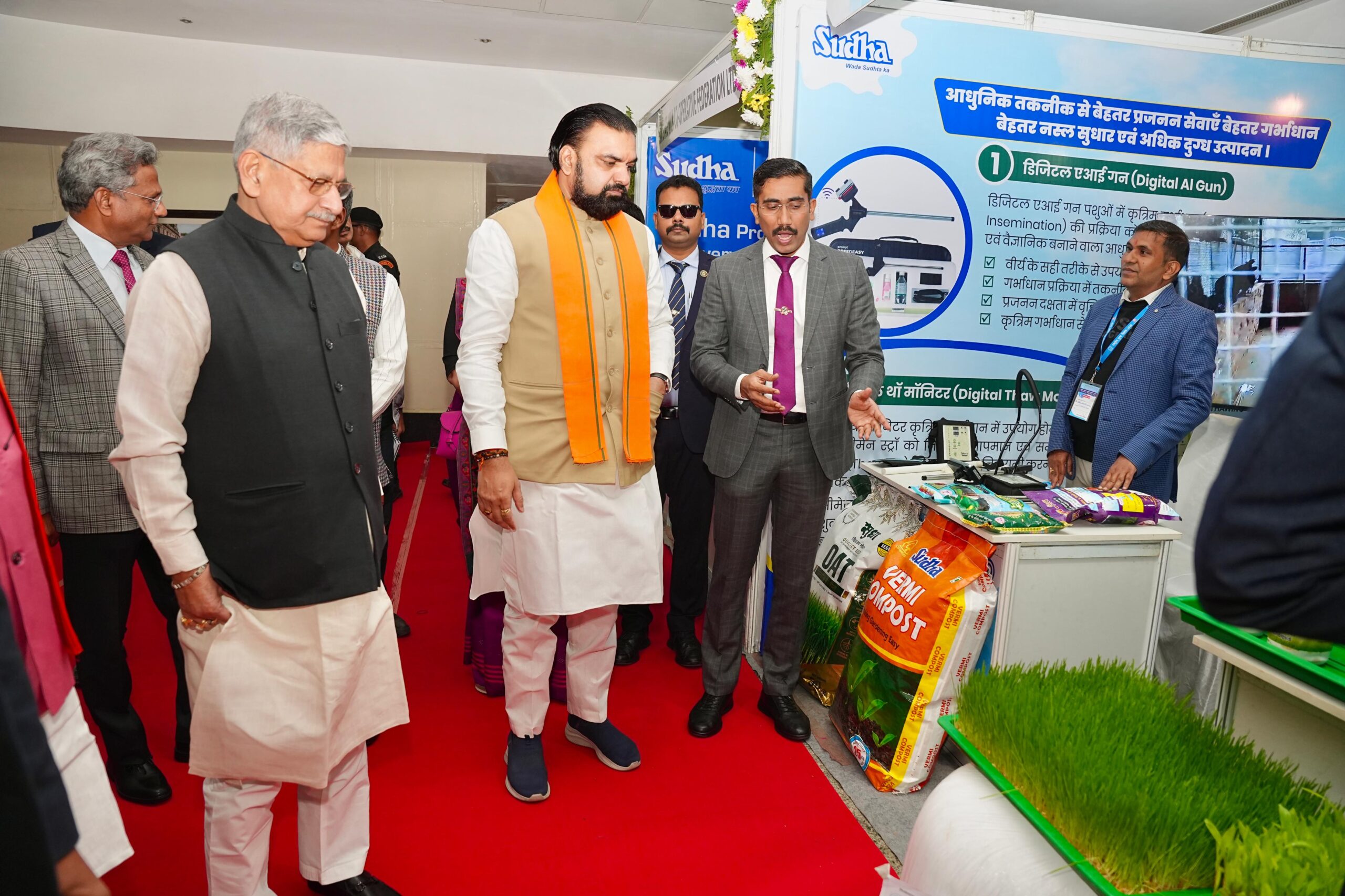
Patna: Bihar aims to position its popular dairy brand Sudha on a par with Amul and establish it among the country’s leading dairy brands. The state has set an ambitious target of producing one crore litres of milk per day by 2030, supported by a series of initiatives to strengthen the dairy sector and improve the income of livestock farmers.
Union Minister for Panchayati Raj and Fisheries, Animal Husbandry and Dairying Rajiv Ranjan Singh alias Lalan Singh announced these initiatives while addressing a ceremony organised at Bapu Sabhagar, Patna, on the occasion of National Milk Day on Wednesday. The programme was inaugurated by Bihar Chief Minister Samrat Choudhary.
The Union Minister said that Bihar currently produces approximately 49 lakh litres of milk daily and is working towards achieving the one-crore-litre daily production target by 2030. As part of efforts to strengthen the dairy sector, the Centre plans to establish 50 new heifer centres this year. One heifer centre has already been approved in Bihar, where work is underway, while two more centres are proposed for approval next year.
On the occasion, 12 individuals and institutions from different states were honoured with Gopal Ratna Awards for their outstanding contributions to milk production and the dairy sector.
The programme also witnessed the release of Basic Animal Husbandry Statistics 2025-26, along with several important initiatives, including a framework and online application portal for the rating and grading of dairy cooperatives and Milk Producer Organisations (MPOs), a climate-resilient guideline for the animal husbandry and dairy sector, and the roadmap for Viksit Bharat @ 2047.
Under the NPDD-JICA initiative, mineral mixture facilities at Patna Milk Union and Tirhut Milk Union, along with an Effluent Treatment Plant (ETP) at Mithila Milk Union, Samastipur, were inaugurated. DPMCU units approved under the National Programme for Dairy Development (NPDD) were also distributed.
Additionally, a milk processing plant with a capacity of two lakh litres per day, established by Namaste India under the Animal Husbandry Infrastructure Development Fund (AHIDF), was dedicated to the nation. Animal medicine outlets were also inaugurated, while two new Sudha products—Makhana Kheer and Rabri—were launched.
White Revolution 2.0 to Strengthen Dairy Cooperatives
Highlighting the achievements of the dairy sector, Union Minister Lalan Singh said that under the leadership of Prime Minister Narendra Modi, granting separate ministerial status to animal husbandry and fisheries has accelerated the development of these sectors.
He stated that India’s milk production has increased from 7.19 crore metric tonnes in 2013-14 to 13.76 crore metric tonnes, registering a growth of approximately 91 per cent over the past 12 years. India continues to be the world’s largest milk-producing country.
The Minister pointed out that nearly 63 per cent of the country’s milk production still comes from the unorganised sector, resulting in difficulties for livestock farmers in receiving fair prices for their produce. To address this challenge, the Central Government, in collaboration with the National Dairy Development Board (NDDB) and the Ministry of Cooperation, is working to bring the unorganised dairy sector into the organised cooperative network.
Under White Revolution 2.0, the government has set a target of establishing 75,000 new dairy cooperative societies and strengthening 46,000 existing societies over five years.
In Bihar, 14,056 new dairy cooperative societies have been established, while 7,435 existing societies have been strengthened. Under the National Programme for Dairy Development (NPDD), 324 projects worth Rs 6,396 crore have been approved across the country. In Bihar, 32 projects worth approximately Rs 498.81 crore have received approval.
Focus on Advanced Breeding Technology

The Union Minister also stressed the importance of sex-sorted semen technology to improve livestock productivity and increase farmers’ income. He said that artificial insemination using this technology offers nearly a 90 per cent probability of producing female calves.
He added that efforts are also underway to improve animal breeds and productivity through In Vitro Fertilisation (IVF) technology. Heifer centres are being developed to facilitate the breeding of superior-quality animals and provide high-quality female calves to livestock farmers.
Government Committed to Making Animal Husbandry Profitable
Addressing the gathering, Bihar’s Minister for Dairy, Fisheries and Animal Resources, Nand Kishore Ram, said the state government is committed to making animal husbandry a profitable occupation through scientific and modern practices.
He said Sudha milk and its products are already available in Bihar and several other states. Efforts are being made to expand their availability across all states of the country.
Secretary of the Union Ministry of Fisheries, Animal Husbandry and Dairying, Naresh Pal Gangwar, said India contributes approximately 25 per cent of global milk production. He further noted that the coverage of artificial insemination in the country has increased from nearly 20 per cent to 42 per cent over the past decade.
Meanwhile, Secretary of Bihar’s Dairy, Fisheries and Animal Resources Department, Shirshat Kapil Ashok, highlighted the rapid progress made by the state in the dairy sector.
He said that following the directions of Chief Minister Samrat Choudhary, Bihar has set a target of achieving daily milk production and procurement of one crore litres.
Over the past six months, 4,900 new dairy cooperative societies have been established, bringing more than 3.23 lakh additional livestock farmers into the cooperative network. This has resulted in an increase of over three lakh litres in daily milk procurement.
The initiatives, he said, are expected to further strengthen Bihar’s dairy infrastructure, expand cooperative participation and enhance the economic condition of livestock farmers.