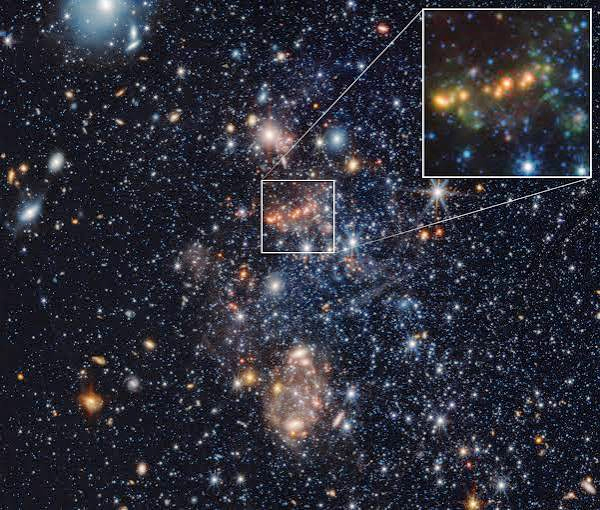
- The event took place in the Andromeda Galaxy, 2.5 million light-years from Earth. The James Webb Space Telescope has gathered crucial data following this stellar merger.
Washington: Astronomers have studied an extremely rare and astonishing event in space. In the outer reaches of the Andromeda Galaxy—located approximately 2.5 million light-years from Earth—a massive star consumed its smaller companion. According to scientists, this discovery is significant for understanding the process of stellar mergers. The event has been designated “AT 2025abao,” with the massive red supergiant star referred to as “Big Bao” and its smaller companion as “Little Bao.”
The study indicates that “Big Bao” had a mass about seven times that of the Sun, with a size approximately 350 times larger and a luminosity about 18,000 times greater. Meanwhile, its smaller companion, “Little Bao,” was estimated to have a mass roughly 70 percent that of the Sun. Scientists estimate that the merger process between the two stars was completed in just seven years.
The star’s brightness began to change in 2018
Scientists first took note of this star in February 2023, when data from various telescopes revealed an unusual level of brightness. A subsequent review of historical astronomical records showed that the star’s luminosity had remained relatively stable until 2018, after which it began to increase gradually.
By September 2024, the star’s brightness had risen significantly, and it was emitting large quantities of dust. Finally, on October 17, 2025, an astronomical monitoring facility recorded a powerful explosion and a sudden spike in temperature. NASA’s James Webb Space Telescope collected data 47 days after the explosion reached its peak. This is considered one of the fastest follow-up observations ever conducted following a stellar merger event.
How did a smaller companion get absorbed into a massive star?
According to scientists, the two stars initially orbited each other for thousands of years. Over time, the larger star—referred to as “Big Bao”—began to grow in size. It expanded to such an extent that the smaller companion star came into contact with its outer gaseous envelope.
In this state, the smaller star—”Little Bao”—began to pull and strip away the outer gas of the massive star. This caused the gas to disperse into space, while the brightness of the primary star intensified. In astronomy, this process is known as “common envelope evolution.”
The drag created by the gas caused the smaller star to lose orbital energy, leading it to gradually spiral toward the core of the massive star. Eventually, Little Bao was absorbed into the center of Big Bao. This collision triggered an explosion, as if a bomb had detonated inside a massive star.

Massive amounts of material ejected into space by the explosion
During this merger, an amount of material equivalent to approximately 0.1 to 0.2 times the mass of the Sun was ejected into space. Scientists analyzed the entire process using mid-infrared data from the James Webb Space Telescope, combined with computer simulations.
This study has provided scientists with a significant opportunity to understand stellar mergers and the process of common envelope evolution. While astronomers have theorized about such events for decades, the chance to observe a star consuming its companion—and to study the resulting effects in such detail—is exceptionally rare.
This discovery could offer new insights into the future evolution of stars, their life cycles, and the explosive events that occur throughout the universe.