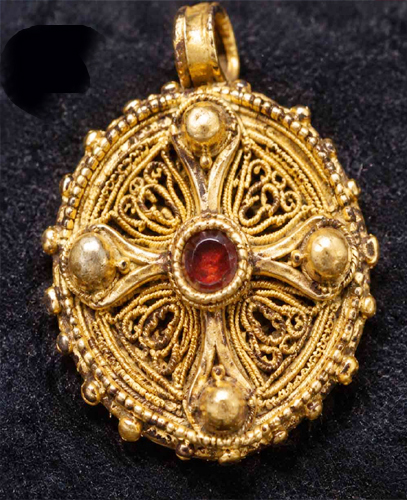
London: A rare and beautifully crafted gold pendant dating back approximately 1,300 years has been discovered in Norfolk, Britain. The remarkable seventh-century jewellery piece has amazed experts with its intricate workmanship, delicate gold designs and historical significance. Archaeologists believe the pendant may have belonged to a Christian woman who regularly wore it around her neck.
The extraordinary discovery was made in February last year in Martham, near Great Yarmouth, using a metal detector. The ancient ornament was found buried beneath the ground and is now undergoing the official Treasure process in Britain.
Measuring just 3.16 centimetres, or approximately 1.2 inches, the pendant is small in size but exceptional in artistic detail. Experts say it features three different types of gold filigree work. Filigree is a traditional jewellery-making technique in which extremely thin gold wires are twisted, shaped and joined together to create intricate decorative patterns.
At the centre of the pendant is a cross-like design, which appears to contain a red stone or glass element. Four sections surrounding the central design feature small raised golden circular decorations, giving the ornament a distinctive appearance.
According to experts, the pendant was made by highly skilled craftsmen. Its exceptional quality reflects the advanced jewellery-making techniques of the early medieval period.
Signs of Wear Reveal Its Historical Story
One of the most interesting features of the pendant is the visible evidence of long-term use. The small loop designed for wearing it around the neck has become noticeably worn. Some of the tiny bead-like decorative elements have also become flattened over time.
Experts believe these marks may have resulted from repeated handling and friction against clothing. This suggests that the pendant was probably worn regularly rather than being reserved exclusively for special occasions. It may have been a treasured personal possession of its original owner.
Multiple Craftsmen May Have Created the Pendant
Creating such detailed patterns on an ornament of this small size would have required considerable skill and patience. Experts believe that several craftsmen with different levels of expertise may have contributed to its production.

An apprentice could have initially drawn the gold into extremely thin wires, which were then twisted and shaped. More experienced artisans would subsequently have assembled the delicate components and completed the intricate decorative work.
Another unusual feature is the use of raised gold decorations instead of gemstones in the four surrounding sections. Jewellery from this period often featured garnets or glass stones. Experts suggest that the unusual design may reflect the craftsman’s artistic choice or the availability of materials at the time.
Pendant May Have Belonged to a Christian Woman
Experts have linked the ornament to a woman because similar circular gold pendants have been discovered in seventh-century female burials. The cross-like design, resembling a four-pointed star, is also considered a possible Christian religious symbol.
The discovery offers valuable insights into early medieval British society, particularly its jewellery-making traditions, religious beliefs and everyday fashion. Beyond its monetary value, the pendant provides a fascinating glimpse into the life of a woman who lived around 1,300 years ago.