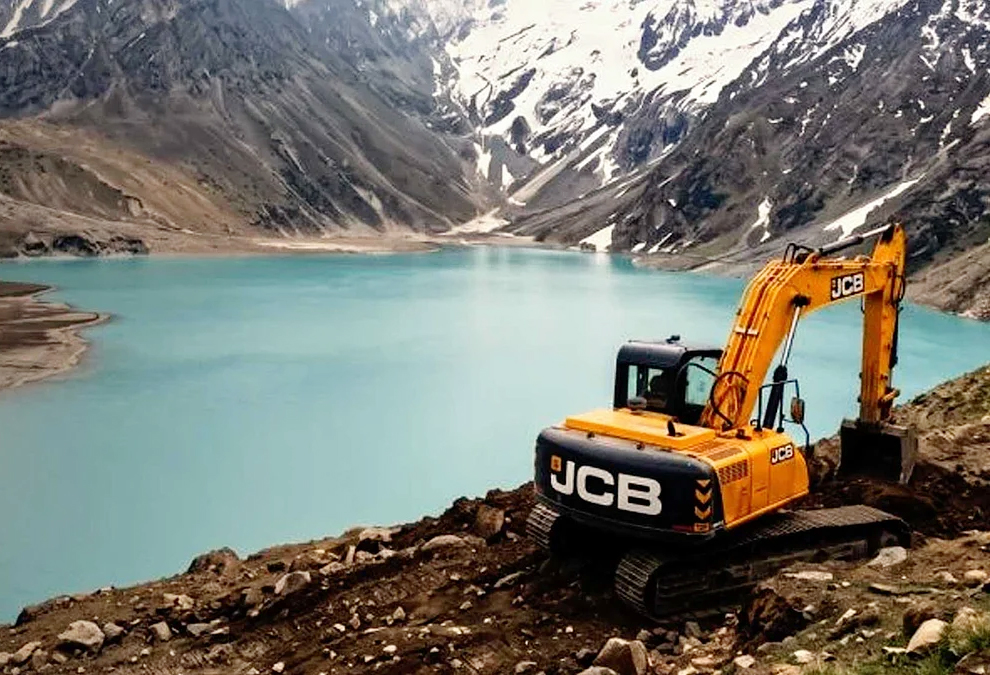
Srinagar: A controversy has erupted after a video showing JCB machines operating near the sacred Sheshnag Lake in Jammu and Kashmir’s Pahalgam region surfaced on social media. The incident has triggered serious environmental and religious concerns, bringing attention to the ecological importance of this high-altitude glacial lake located along the Amarnath Yatra route.
Political reactions have also started emerging over the issue. PDP president Mehbooba Mufti was reportedly stopped by police at Chandanwari while attempting to visit Sheshnag Lake, further highlighting the growing sensitivity surrounding the matter.
Meanwhile, the Border Roads Organisation (BRO) has clarified that the ongoing work is intended only to improve the safety and accessibility of the existing track for pilgrims. The organisation has stated that construction activities are being carried out in accordance with prescribed safety standards and environmental safeguards. These include the proper disposal of excavated material, protection of natural drainage channels and measures to minimise damage to the surrounding landscape.
Beyond the political controversy, environmental experts point out that Sheshnag Lake is much more than a religious or tourist destination. Situated at an altitude of approximately 3,590 metres above sea level, the lake depends primarily on water from melting glaciers and snow.
The surrounding landscape consists of high mountains, snow-covered slopes, rocky surfaces and loose soil deposits. Much of the terrain contains glacial moraines, which are mixtures of rocks, gravel, sand and soil left behind by retreating glaciers. Such formations are naturally unstable and particularly vulnerable to heavy construction activities.
Environmentalists warn that operating heavy machinery, excavating land and expanding roads near the lake could affect the entire surrounding ecosystem, not just the lake water.
Excavation can loosen soil and rocks, increasing the possibility of erosion and slope instability. If construction debris accumulates near the lake, rainfall, wind and water runoff could carry sediment into it. Increased sedimentation may reduce water quality and disturb algae, microorganisms and other aquatic life.
Road cutting and construction could also alter natural drainage patterns and obstruct the channels through which water reaches the lake. Since the Sheshnag and surrounding glacier catchment areas are connected to streams and rivers in the Lidder Valley, changes in water flow could have wider ecological consequences.

Another major concern is the possibility of a Glacial Lake Outburst Flood (GLOF). Such floods occur when the natural barrier holding back glacial lake water weakens or collapses, releasing large volumes of water downstream. Heavy machinery, excavation and changes to the natural terrain could potentially increase instability in vulnerable areas.
Sheshnag is among 14 glacial lakes in Jammu and Kashmir that have been identified as high-risk lakes, making environmental protection particularly important.
The surrounding region is also home to several Himalayan wildlife species, including brown bears, ibex and snow leopards. Construction noise, increased human movement and habitat disturbance could affect their movement, feeding patterns and breeding environments.
The controversy has therefore raised an important question: how can infrastructure development for pilgrims be balanced with the protection of a fragile Himalayan ecosystem? Experts stress that construction in such sensitive high-altitude regions requires careful environmental assessment, scientific monitoring and strict safeguards.