World News : Narendra Modi on Thursday said that India and Australia are emerging as natural and trusted partners at a time of global uncertainty, supply chain disruptions, and energy challenges. He called on businesses from both countries to deepen cooperation in sectors such as clean energy, nuclear power, critical minerals, artificial intelligence, semiconductors, infrastructure, and education, stating that India and Australia can jointly develop solutions to global challenges.
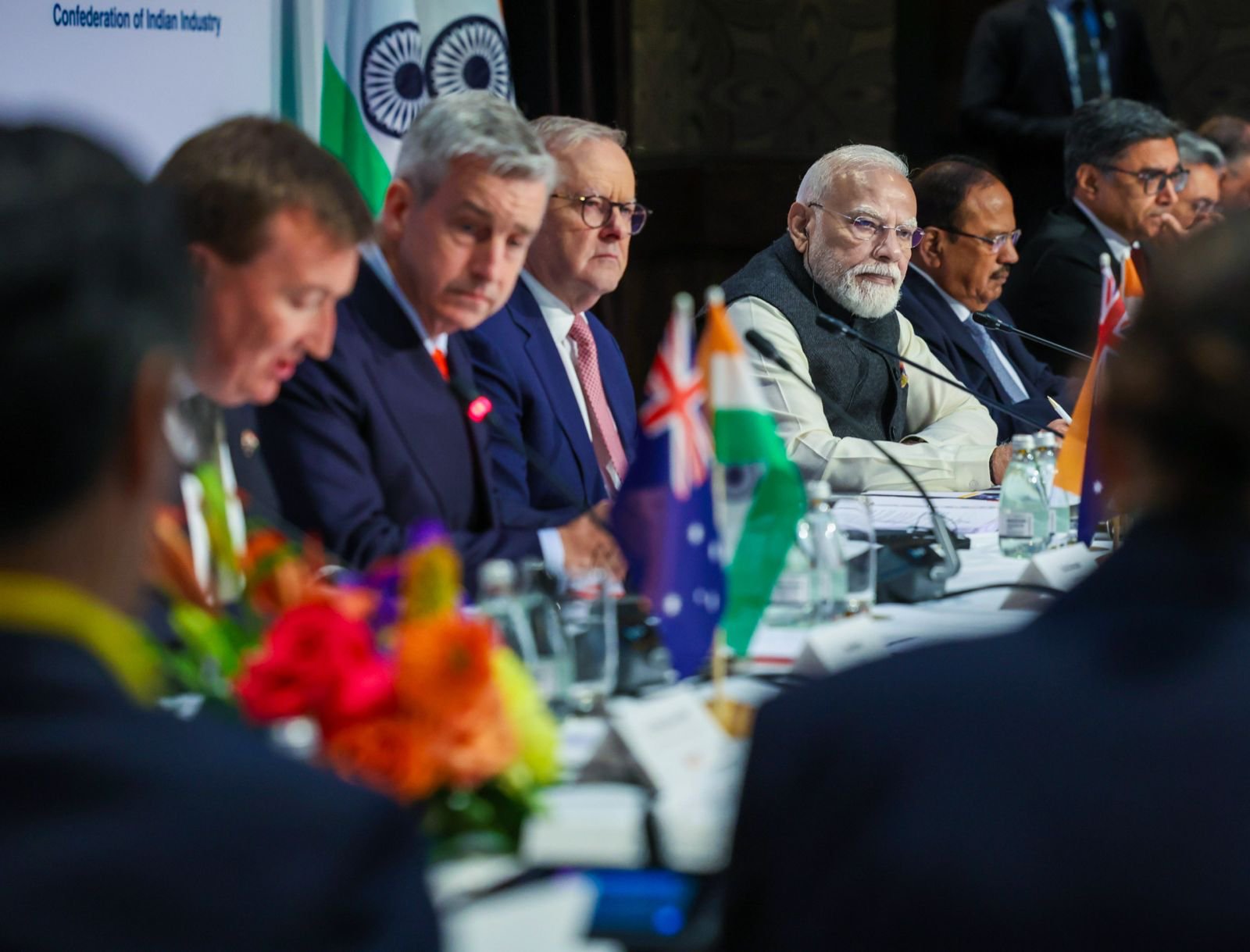
Addressing the Economic Roadmap Business Reception in Melbourne, the Prime Minister said the India-Australia Economic Cooperation and Trade Agreement (ECTA), signed in 2022, has significantly strengthened economic ties between the two nations. He noted that India’s exports to Australia have doubled since the agreement came into force and urged both countries to finalize the proposed Comprehensive Economic Cooperation Agreement (CECA) at the earliest.
Focus on Clean and Nuclear Energy
Prime Minister Modi said India is working toward achieving 500 GW of renewable energy capacity by 2030 and net-zero emissions by 2070. He highlighted that Australia’s technology, investment, and resources in green hydrogen, solar, wind, and hydropower could accelerate India’s clean energy transition.
He also noted that India has recently opened its nuclear energy sector to private participation through the Shanti Act and aims to generate 100 GW of nuclear power by 2047. According to Modi, Australia’s vast uranium reserves present a historic opportunity for cooperation in the nuclear energy sector.
Investment Opportunities in Infrastructure
The Prime Minister emphasized India’s rapidly expanding infrastructure sector, saying there are significant long-term investment opportunities in ports, airports, highways, railways, and urban infrastructure.
He pointed out that India is currently building nearly 34 kilometres of national highways and more than 8 kilometres of new railway lines every day, reflecting the country’s pace, scale, and commitment to development.
Collaboration in AI and Semiconductors
Modi said the Indian government has committed more than $10 billion to support the country’s Artificial Intelligence Mission, Quantum Mission, and semiconductor programme.
He encouraged greater collaboration between India and Australia in data centres, AI, quantum technologies, semiconductors, and digital public infrastructure, saying joint efforts could produce globally relevant technological solutions.
Invitation to Australian Investors
The Prime Minister invited Australian pension funds to invest in India, describing the country as a secure, stable, and sustainable investment destination.

He said pension funds in India represent the trust of millions of families, and the government is committed to protecting investor confidence while ensuring steady returns on capital.
Education and Talent Partnership
Highlighting educational cooperation, Modi said the establishment of campuses by leading Australian universities in India’s GIFT City reflects Australia’s confidence in India’s growth potential.
He stressed the need to transform student exchange programmes into long-term talent partnerships that benefit both countries.
Strengthening State-Level Partnerships
The Prime Minister proposed direct economic partnerships between Indian states and Australian states based on their respective strengths.
He suggested linking:
- Western Australia’s critical mineral resources with the manufacturing capabilities of Odisha and Gujarat.
- Queensland and Tasmania’s clean energy expertise with India’s renewable energy corridors.
- The financial and innovation ecosystems of New South Wales and Victoria with Maharashtra, Karnataka, and Telangana.
Shared Strategic Vision
Concluding his address, Modi said the India-Australia strategic partnership continues to grow on the foundation of shared democratic values and a common vision for a free, open, and inclusive Indo-Pacific region.
He expressed confidence that the business dialogue would lead to new ideas, stronger partnerships, increased investment, and long-term economic cooperation between the two countries.