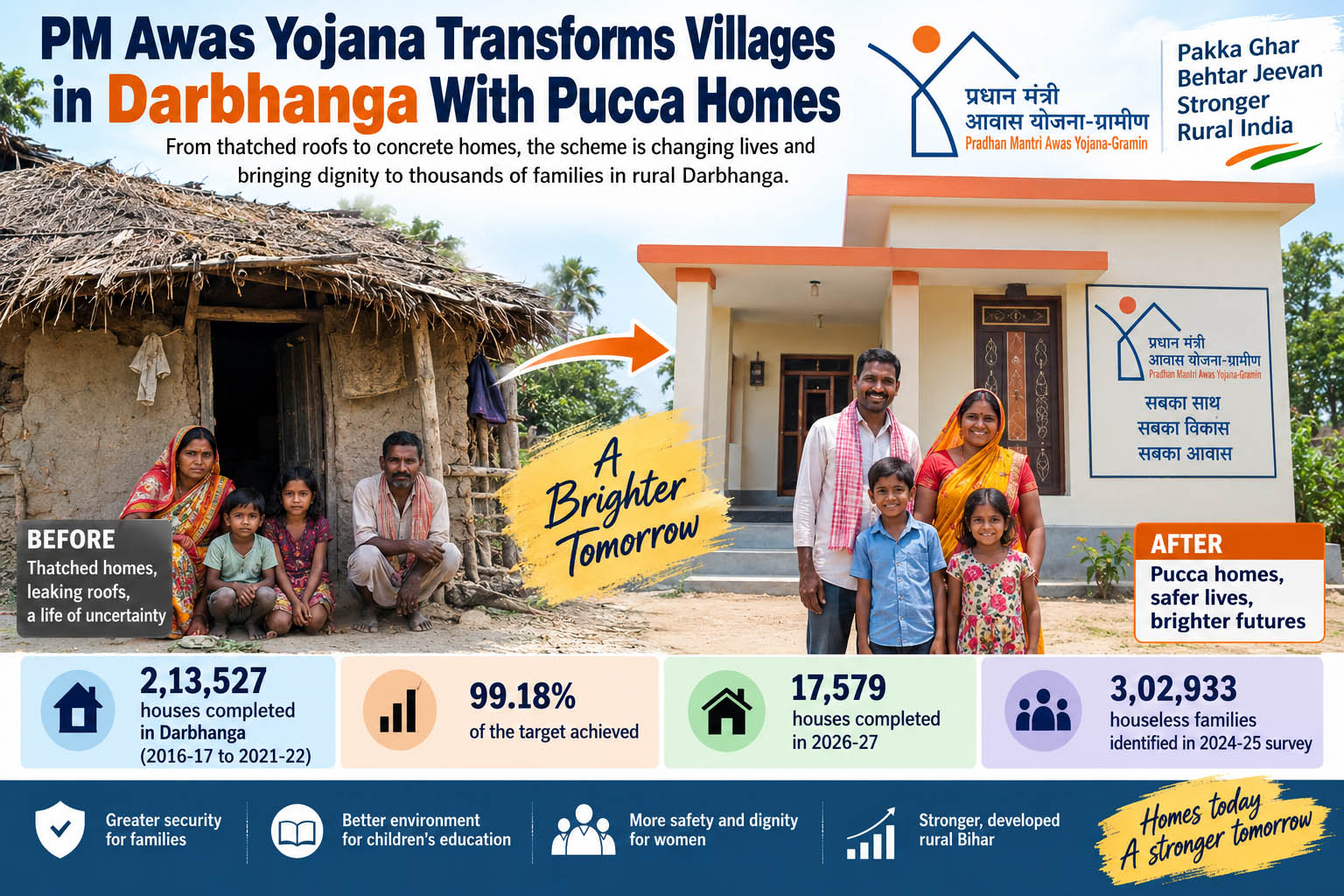
Bihar News : Mud walls, thatched roofs and leaking houses during the monsoon were once a common feature of rural life. For families living in huts, spending a night during heavy rain was often a challenge. For such families, the Pradhan Mantri Awas Yojana-Gramin (PMAY-G) has emerged not just as a government scheme but as a means of getting a secure pucca roof and living with dignity.
Over the past few years, a major change has been visible in the rural areas of Darbhanga district. Where thatched and tiled houses once dominated the landscape, a large number of pucca houses can now be seen. Having a permanent home has long been one of the biggest needs of poor families, and the housing scheme has played an important role in addressing this need.
Journey From Hut to Pucca House
Under PM Awas Yojana-Gramin, priority is given to families who are homeless or forced to live in kutcha and dilapidated houses. Financial assistance provided under the scheme helps beneficiaries construct pucca homes.
For many families, it is the first time they have a house that provides protection from rain, storms and extreme heat. The change can be clearly seen across villages in Darbhanga.
Families that once lived under thatched roofs now have brick-and-cement houses in their courtyards. Children have a safer place to study, while women and elderly family members have greater protection from harsh weather conditions.
More Than 2.13 Lakh Houses Completed
According to available government data, 2,13,527 houses under PM Awas Yojana-Gramin were completed in Darbhanga district between financial years 2016-17 and 2021-22. This represented 99.18% of the निर्धारित target.
The figure indicates the large-scale implementation of the scheme in rural areas of the district. Housing construction has continued beyond this period.
At a district-level programme, information was provided that 17,579 houses were completed during financial year 2026-27. Beneficiaries of completed houses were welcomed into their new homes, while new beneficiaries were given sanction letters.
Pucca Houses Boost Confidence Among Poor Families
For a poor family, a pucca house is more than four walls. It represents security, dignity and a foundation for the future. Families living in thatched huts often worried every monsoon about their homes collapsing or household belongings getting soaked. A pucca house has provided considerable relief from such concerns.
A secure home also affects children’s education. It provides them with a better environment and a safe place to study. For women, a pucca house also provides a greater sense of security and privacy.
In this sense, the impact of the housing scheme extends beyond construction and is connected to changes in the overall living conditions of rural families.
Housing Landscape Changing Across Villages
Large numbers of new pucca houses are now visible along roads and inside villages across rural Darbhanga. Thatched roofs are gradually being replaced by permanent roofs.
However, several poor families in the district still live in kutcha or dilapidated houses. This is also reflected in the 2024-25 housing survey, under which 3,02,933 houseless families were reportedly identified in the district.
The figure also shows that despite a large number of families benefiting from the scheme, the need for housing has not been completely eliminated. Families identified through the survey are not automatically considered eligible for the scheme. Final selection is made after eligibility assessment and verification.
Challenge Now Is Reaching Every Eligible Family
PM Awas Yojana has played an important role in changing the rural landscape of Darbhanga. The next challenge is to reach families who are still living in huts, thatched structures or dilapidated houses.
The focus now needs to be on transparent selection of genuinely needy families, timely approval and timely release of the prescribed instalments for construction.
The transformation of villages is not yet complete, but the change is clearly visible. Where thatched huts once stood, pucca houses can now increasingly be seen across the villages of Darbhanga.