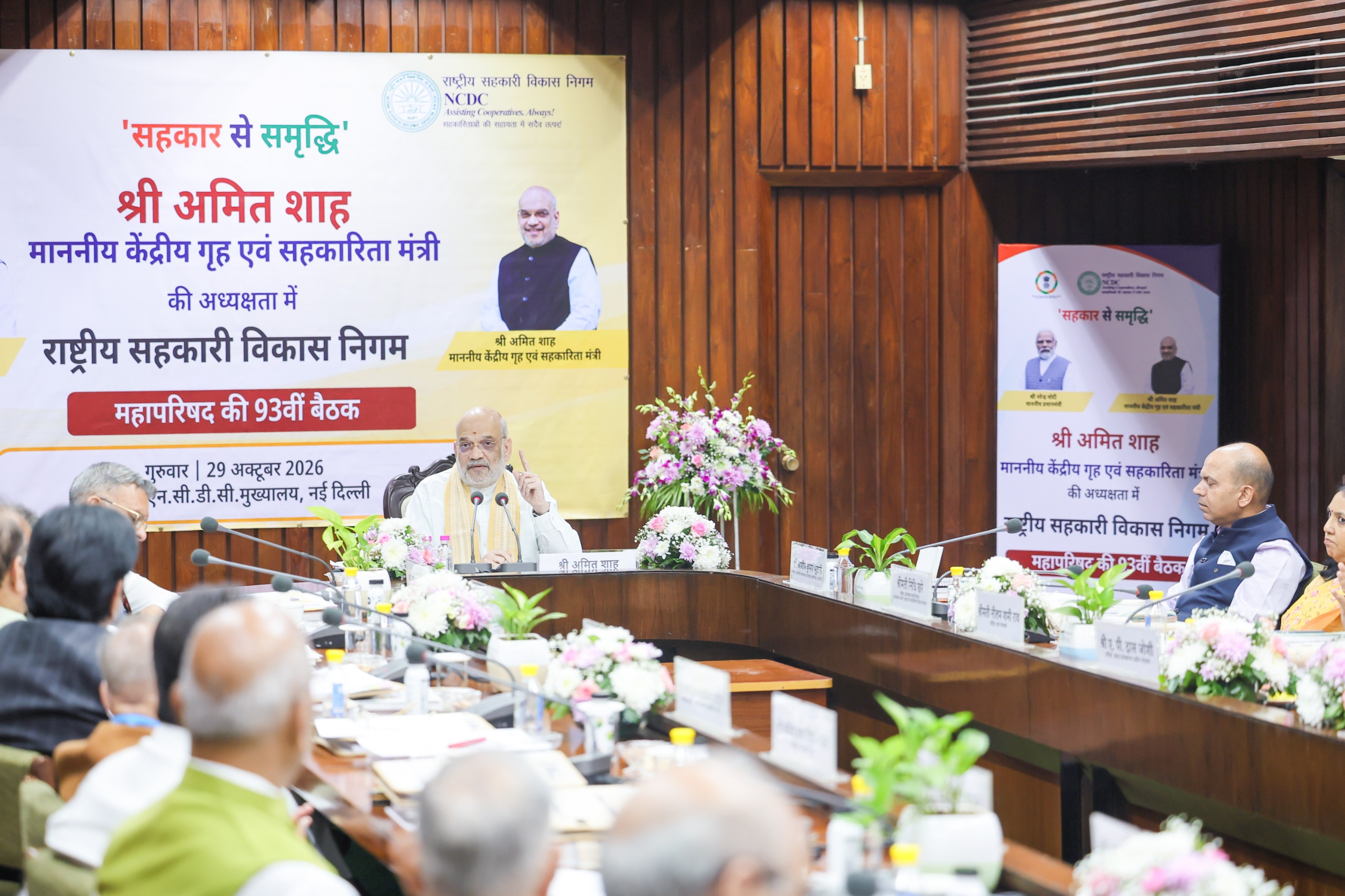
New Delhi: Union Home and Cooperation Minister Amit Shah has directed the National Cooperative Development Corporation (NCDC) to prepare a comprehensive 25-year roadmap. He emphasized that while the administration of the cooperative sector must be professional, its core approach should remain firmly rooted in the fundamental principles of cooperation.
Presiding over the 93rd General Council meeting of the NCDC, Shah suggested the formation of a group comprising experienced representatives from the cooperative sector and professional experts. This group would be tasked with reviewing the organization’s structure, strategies for mobilizing financial resources, operational improvements, and future business prospects. He stated that, in line with Prime Minister Narendra Modi’s vision of ‘Sahkar se Samriddhi’ (Prosperity through Cooperation), the cooperative sector must be developed into a robust vehicle for growth—one whose benefits reach every segment of society.
Since the establishment of the Ministry of Cooperation, the NCDC has disbursed over ₹4.14 lakh crore in financial assistance to cooperative institutions across the country (up to October 25). In the 2025-26 financial year, the Corporation disbursed ₹1,27,596 crore, while recording a net profit of ₹1,475 crore. The Corporation achieved a loan recovery rate of 99.84 percent, with its net Non-Performing Assets (NPA) standing at zero.
Commending the progress made by the NCDC over the last five years, Shah described this period as a ‘golden era’ for the organization. He noted that the Corporation has established its presence across all states and union territories in the country. The expansion of its offices into remote regions—such as Ladakh and the smaller states of the Northeast—marks a significant step toward extending the cooperative movement to the farthest corners of the nation. He stated that the NCDC should not rest on its past achievements; instead, it must pursue institutional reforms, enhance its capacity to mobilize financial resources, and develop new models of partnership with cooperative institutions to align with evolving needs. He suggested holding a dedicated meeting after March 31, 2027, for a detailed discussion, with the aim of making progress toward necessary decisions by December 2027.
The Home Minister emphasized that through the cooperative movement, the collective strength of small farmers, livestock rearers, fishers, rural women, and economically weaker sections can be integrated into national development. He noted that the NCDC’s mandate extends beyond providing financial assistance to large cooperative institutions; it also encompasses directly improving the livelihoods of small farmers, livestock rearers, and fishers.
Shah directed the formulation of specialized cooperative projects aimed at making the Northeastern region self-reliant in animal husbandry, dairy, and fisheries by 2030. He noted that achieving self-reliance in these sectors could boost the region’s income by approximately ₹32,800 crore and generate around 8 lakh employment opportunities. He instructed NCDC offices in the region to collaborate with state governments to develop viable projects and secure the necessary financial arrangements for them.
He further suggested that the NCDC should develop joint credit-delivery models in partnership with the National Bank for Agriculture and Rural Development (NABARD), state cooperative banks, and commercial banks. Shah stressed the need to devise new financing models to address the financial requirements of the dairy cooperative sector.

To accelerate the disbursement of financial assistance, Shah stated that the NCDC should work toward achieving targets of ₹1.70 lakh crore in the 2026-27 financial year, ₹2.10 lakh crore in 2027-28, and ₹2.50 lakh crore in 2028-29. He suggested setting ambitious targets for the coming years as well. He emphasized striving toward the disbursement of annual financial assistance amounting to approximately Rs 3.50 lakh crore by the financial years 2029-30 and 2030-31.
The meeting included a review of the NCDC’s financial performance, annual accounts, and reports for the financial year 2025-26. During this period, the Corporation approved projects worth Rs 1,55,408 crore, designed to benefit 14,881 cooperative societies. The Corporation’s annual financial disbursement grew from Rs 24,733 crore in the financial year 2020-21 to Rs 1,27,596 crore in 2025-26.
Shah also commended the NCDC’s role in the formation and development of national-level multi-state cooperative entities. These include the National Cooperative Exports Limited, Bharatiya Beej Sahakari Samiti Limited, National Cooperative Organics Limited, Bharat Taxi, Sahkar Sarathi, and the NUCFDC—the apex organization for urban cooperative banks. He further stressed the need to develop new business models based on a circular economy for cooperative sugar mills, and to integrate youth who have completed training and internships under the ‘Sahkar Mitra’ program into these new multi-state cooperative entities.
The meeting also covered the NCDC Amendment Act, 2026, and the ‘Sahkar Navachar Yojana’ (Cooperative Innovation Scheme). Under this scheme, eligible cooperative societies are entitled to 100 percent grant assistance of up to Rs 25 lakh. So far, grant assistance totaling Rs 85 lakh has been approved for five cooperative societies. Additionally, the Corporation has facilitated the registration of 1,863 Farmer Producer Organizations (FPOs) within the cooperative sector, 1,117 of which were formed through Primary Agricultural Credit Societies (PACS). FPOs and related entities by October 2026