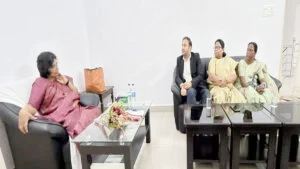
- National Commission for Women (NCW) Chairperson Vijaya Rahatkar held review meetings in Ranchi and Gumla, issuing directives to secure digital evidence and ensure accountability for negligent officials.
Ranchi/Gumla: The National Commission for Women (NCW) has adopted a strict stance regarding the suspicious death of tribal woman leader Nisha Bhagat. During her visit to Jharkhand, NCW Chairperson Vijaya Rahatkar met with the victim’s family and held discussions with police and administrative officials in Ranchi and Gumla to review the progress of the investigation. Key concerns were raised regarding the role of the then-Station House Officer (SHO) of Pithoria, Satish Pandey; the allegations against other accused, including Ajay Tirkey; and the alleged negligence on the part of the police.
In a written complaint, Nisha Bhagat’s father leveled serious allegations against the then-SHO, Satish Pandey. Questions have been raised as to why his name was not included in the First Information Report (FIR). The NCW Chairperson questioned officials on the basis for excluding the officer from the FIR, despite his name appearing in the complaint. Emphasis was also placed on investigating an alleged telephonic conversation between Nisha and the then-SHO, with a focus on the scientific analysis of call recordings and other technical evidence.
Questions raised over Satish Pandey’s role; emphasis placed on investigating call recordings.
Nisha Bhagat’s father has named the then-Pithoria SHO, Satish Pandey, as one of the primary accused in his complaint. It is alleged that Nisha had previously reported the harassment and distress she was facing, but no appropriate action was taken on her complaints.
The NCW Chairperson reviewed the steps taken by the police in response to Nisha’s earlier complaints. Furthermore, she stressed the necessity of recovering the recording of the alleged final telephonic conversation between Nisha and the then-SHO and subjecting it to a forensic examination. It will be crucial to clarify during the investigation what information Nisha provided—regarding her personal safety or mental distress—during her interactions [with authorities], and what actions were subsequently taken by the police.
Allegations of harassment and land grabbing against Ajay Tirkey and others
In the case concerning the death of Nisha Bhagat, serious allegations—including mental harassment, illegal land grabbing, looting of her home, and intimidation—have been leveled against Ajay Tirkey and several others. Family members and other complainants allege that Nisha had been subjected to prolonged harassment.
Prior to her death, Nisha had mentioned—in posts shared on social media—that she was deeply distressed by online harassment, character assassination, and false accusations. Given this, the Commission has deemed it essential to examine previously filed complaints and the police’s response to them.
A key challenge for the investigative agencies will be to determine what action, if any, the relevant authorities took regarding the complaints filed by Nisha concerning a land dispute, alleged illegal occupation, looting, and harassment on social media. However, these allegations can only be verified following a thorough investigation.
Commission expresses concern over the absence of the DGP, DCs, and SPs
The absence of the Director General of Police (DGP) of Jharkhand, as well as the Deputy Commissioners (DCs) and Superintendents of Police (SPs) of Ranchi and Gumla, from the review meeting chaired by the Chairperson of the National Commission for Women (NCW) was also raised. It was reported that these officials cited a gazetted holiday and law-and-order commitments as reasons for their absence.
Vijaya Rahatkar expressed concern regarding the absence of these senior officials. She emphasized that in a serious matter such as the suspicious death of a tribal woman, the presence and accountability of senior officials are paramount. The Commission stressed the need to ensure that there is no negligence in the investigation and that every aspect is examined with the utmost seriousness.
Forensic analysis to be conducted on Facebook Live, mobile data, and CCTV footage
Preserving digital evidence is a critical component of the investigation. During the Commission’s review meeting, special emphasis was placed on securing key evidence, including Nisha Bhagat’s final Facebook live video, her mobile phone, call detail records (CDR), WhatsApp messages, and footage from CCTV cameras installed in the vicinity of the incident site.

It was stressed that all this electronic evidence must be examined by the Forensic Science Laboratory (FSL) in a time-bound manner to prevent the loss of crucial information or any tampering with the evidence.
Furthermore, the progress made so far by the Special Investigation Team (SIT)—constituted to probe the case—was reviewed, along with findings from the post-mortem and FSL reports. The Commission underscored the need to hold police officers accountable and take appropriate action against them should any negligence or irregularities on their part come to light.
Local administration’s responsibility remains, even after the announcement of a CBI probe
Following Chief Minister Hemant Soren’s announcement of a CBI investigation into the death of Nisha Bhagat, the victim’s family now holds hope for an impartial inquiry. The state government has also constituted an SIT to investigate the matter. The Chief Minister has made it clear that those who violate the dignity of a tribal woman will not be spared, and that strict action will be taken against the guilty.
However, the Chairperson of the National Commission for Women clarified that the mere announcement of a CBI investigation does not absolve the local police and administration of their responsibilities. Until the CBI formally takes over the case, local agencies must ensure that all evidence is preserved and that transparency is maintained throughout the investigative process.
The Commission also emphasized the need to ensure that the victim’s family and witnesses are not subjected to any form of intimidation.