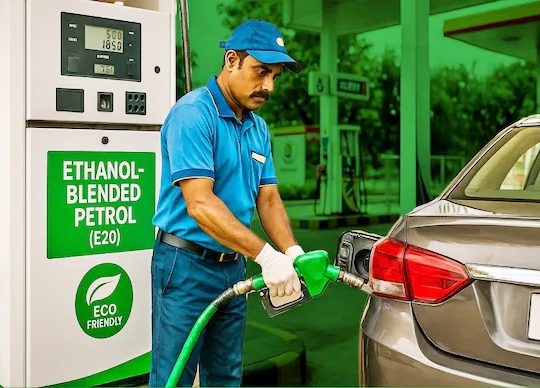
More News: The Government of India is rapidly advancing its efforts to promote biofuel by blending ethanol with petrol. This initiative began at select petrol pumps in 11 states and union territories, but it is now available at almost all petrol stations.
Ethanol (C₂H₅OH) is an organic fuel mainly derived from sugar-rich crops like sugarcane and maize. It is produced through the fermentation of sugar. When ethanol is mixed with petrol, the resulting fuel is called ethanol-blended fuel. In E20 fuel, “E” stands for ethanol and “20” represents its percentage in the blend. This means E20 contains 20% ethanol and 80% traditional petrol.
Using ethanol not only reduces greenhouse gas emissions but is also more cost-effective compared to petrol. Additionally, it helps India reduce its dependence on imported crude oil. This is why the government is emphasizing its large-scale adoption.
Now the question arises — how can you know if your car is suitable for E20 fuel?
Most vehicle manufacturers place an E20 compatible or E20 fuel sticker on the fuel cap, tank, or windshield of their new vehicles. This indicates that the vehicle is certified for ethanol-blended fuel. You can also check your car’s owner’s manual, which clearly states whether the vehicle is compatible with E10, E20, or flex-fuel.

Some manufacturers also provide this information online using the Vehicle Identification Number (VIN), which can be found on the car’s registration certificate and on the vehicle itself. If you are still unsure, you can confirm with your car manufacturer’s customer care or an authorized dealership.