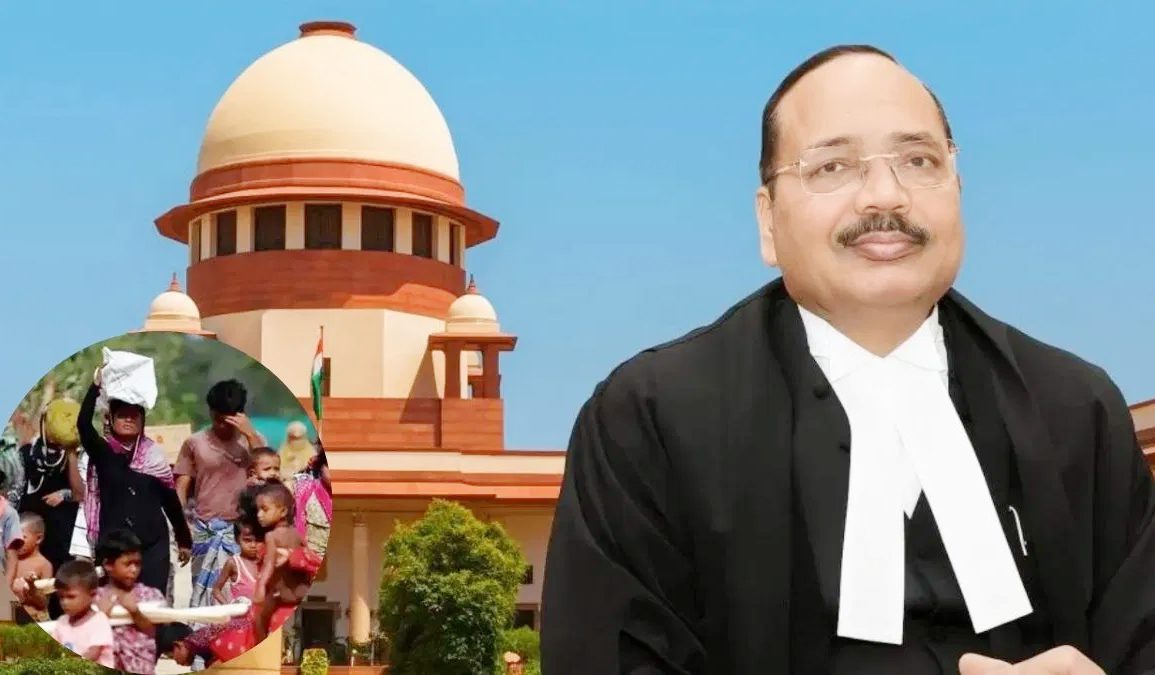
India News : The Supreme Court has come under sharp criticism following its remarks on the legal status of Rohingya Muslims during a hearing on December 2. A group of former judges, senior lawyers, and members of the Campaign for Judicial Accountability and Reforms have written a formal letter to Chief Justice of India (CJI) Justice Suryakant, expressing strong objection to the court’s observations.
In their letter, the signatories stated that the remarks were “inhumane” and contrary to the spirit of the Indian Constitution, particularly Article 21, which guarantees the right to life and personal liberty. They warned that such statements from the apex court risk undermining constitutional morality and judicial credibility.
Background of the Controversy
The comments were made by a bench comprising CJI Justice Suryakant and Justice Joymalya Bagchi while hearing a habeas corpus petition. During the proceedings, the bench questioned whether individuals who entered India illegally should be “welcomed with a red carpet when citizens of the country themselves are struggling with poverty.”
This observation triggered a nationwide debate within legal and human rights circles.
Concerns Raised in the Letter
The former judges and legal experts emphasized that the Rohingya community is globally recognized as one of the most persecuted minorities, having faced decades of violence, discrimination, and denial of citizenship in Myanmar. International bodies and courts have described the actions against Rohingyas as acts of ethnic cleansing and genocide.
The letter argued that labeling Rohingya asylum seekers merely as illegal immigrants weakens the judiciary’s moral authority. It further noted that statements made by the Chief Justice carry influence beyond the courtroom and shape perceptions across lower courts, administrative agencies, and public institutions.

Courtroom Arguments
During the hearing, the bench questioned whether individuals without legal authorization to stay in India should be entitled to food, shelter, and education. The petition, filed by activist Rita Manchanda, alleged that several Rohingya individuals were picked up by Delhi Police in May and had since gone missing.
She cited a 2020 Supreme Court ruling, which held that Rohingyas could be deported only by following due legal procedure.
Centre’s Stand
Appearing for the Centre, Solicitor General Tushar Mehta argued that the petition lacked locus standi, as it was filed by an activist rather than by any direct victim. The bench stated that it first needed to determine whether Rohingyas qualify as refugees or are illegal foreign nationals.
The episode has reignited discussion on the balance between national security, constitutional responsibility, and humanitarian obligations, highlighting the delicate role of the judiciary in matters involving vulnerable communities.