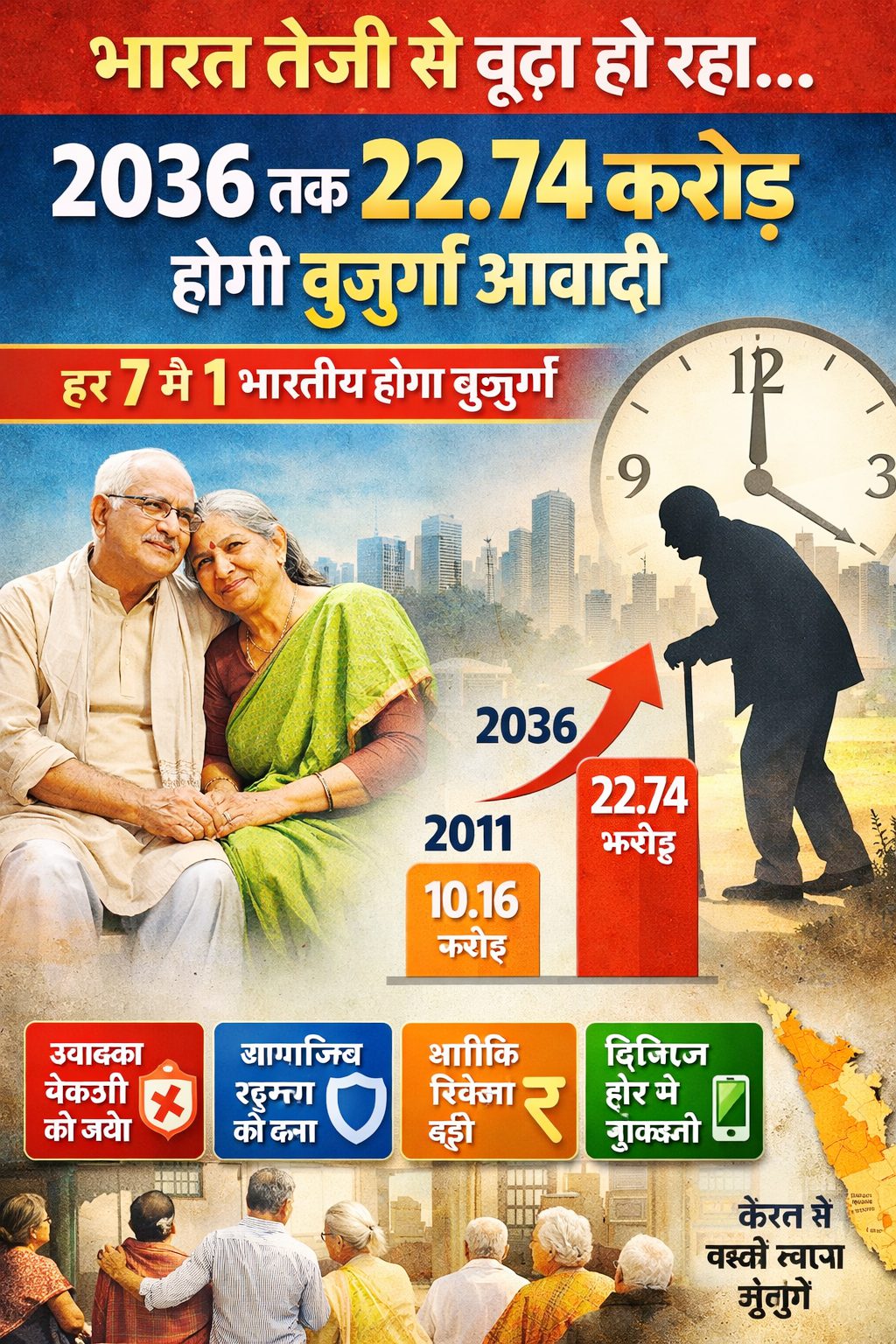
India News : India is rapidly moving towards an ageing population, with the number of senior citizens expected to rise sharply over the next decade. According to data shared by Union Minister of State for Home Affairs Nityanand Rai in a written reply in the Lok Sabha, the population of people aged 60 years and above will increase from 101.6 million in 2011 to 227.4 million by 2036.
This means the share of elderly citizens in India’s total population will rise from 8.4 percent to nearly 14.9 percent, making one out of every seven Indians a senior citizen by 2036. The government acknowledged that this demographic shift will bring several challenges, including healthcare needs, social security, economic dependency, and access to digital services.
The minister also highlighted that changing family structures have significantly impacted elderly care in India. Traditionally, joint families ensured shared responsibility for senior citizens. However, the rise of nuclear families has reduced support systems, placing greater pressure on fewer caregivers and increasing the vulnerability of older adults.
To address these challenges, the central government launched the Atal Vayo Abhyuday Yojana (ABVY) on April 1, 2021. The scheme aims to provide comprehensive support services for senior citizens across the country, focusing on health, welfare, financial security, and social engagement. Additionally, the government has constituted the National Council of Senior Citizens, chaired by the Union Minister for Social Justice and Empowerment, to advise on policies and programmes related to elderly welfare.
Kerala currently has the highest proportion of elderly citizens in the country. Around 16.5 percent of its population—approximately 5.6 million people—are aged 60 years or above, and nearly 11 percent are over 80 years old. By 2031, the elderly population in Kerala is projected to reach 25 percent.

The Kerala Migration Survey conducted by the International Institute of Migration and Development (IIMD) revealed that out of the state’s 34.3 million population, at least one member from every fifth household lives outside the state. More than 1.2 million houses remain locked, while over 2.1 million households are occupied only by elderly residents.
Experts believe that India must strengthen healthcare infrastructure, pension systems, and community-based support mechanisms to effectively manage the growing elderly population in the coming decades.