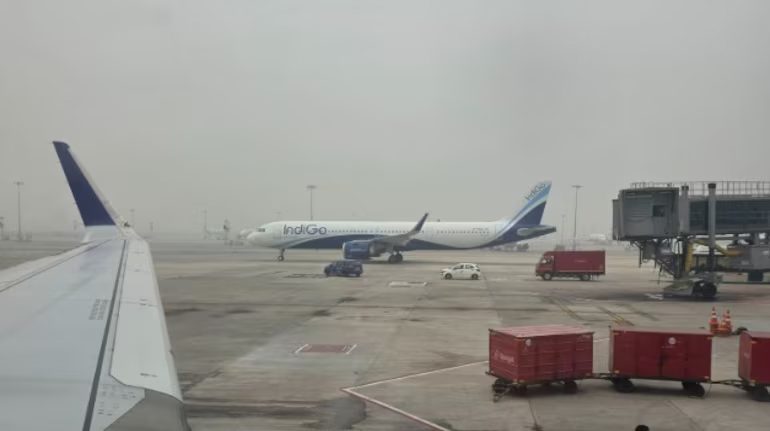
India News : Dense fog has once again disrupted air traffic in the national capital, causing delays to several flights arriving at and departing from Delhi. Due to extremely low visibility, aircraft operations have become challenging, prompting authorities at Indira Gandhi International Airport to implement CAT-III (Category III) landing procedures.
As a thick layer of fog enveloped the city, visibility dropped to critically low levels, forcing pilots to rely entirely on onboard instruments rather than visual cues while landing.
✈️ What Is the CAT-III Landing System?
CAT-III is an advanced Instrument Landing System (ILS) that allows aircraft to land safely even when visibility is extremely poor. This system is used when pilots cannot clearly see the runway from the cockpit and must depend on automated guidance and precision instruments.
However, CAT-III operations require:
-
Aircraft equipped with CAT-III-compatible systems
-
Specially trained and certified pilots
-
Runways fitted with high-intensity lighting and advanced navigation aids
🌫️ Why Are Low-Visibility Procedures Implemented?
When visibility suddenly drops due to dense fog, airports switch to Low Visibility Procedures (LVPs). These protocols determine which aircraft are permitted to land, which pilots are certified for such operations, and whether flights should be delayed, diverted, or held in the air.
🔍 Key Terms: Decision Height and Runway Visual Range
Two critical terms are associated with CAT-III landings:

-
Decision Height (DH): The altitude at which a pilot must decide whether to continue landing or execute a go-around. In CAT-III conditions, DH can be less than 100 feet or even zero, depending on the sub-category.
-
Runway Visual Range (RVR): The distance a pilot can see runway markings or centerline lights. CAT-III systems function even at extremely low RVR levels.
CAT-III is further divided into CAT-III A, B, and C, each permitting landings under progressively poorer visibility conditions.
🚨 Airlines Alert Passengers
Following the implementation of CAT-III procedures, airlines such as IndiGo and Air India have informed passengers about possible delays and operational disruptions.
Passengers are advised to regularly check their flight status through airline apps or official airport updates before traveling.
While CAT-III technology enables safe aircraft operations during severe fog, delays remain common as safety remains the top priority in such weather conditions.