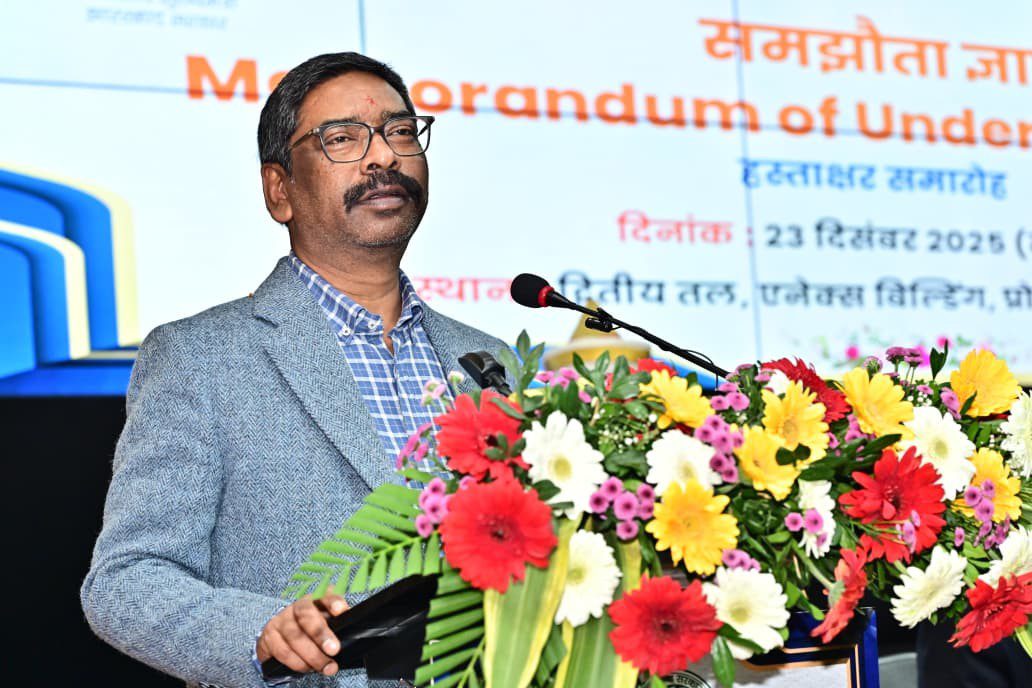
Jharkhand News : Jharkhand Chief Minister Hemant Soren on Thursday announced that a committee will soon be formed to identify the families of tribal martyrs of the Kharsawan firing incident. He said the families of those martyred in the 1948 police firing would be honoured on the lines of the victims’ families of the Gua firing incident.
The Chief Minister paid floral tributes to the tribal martyrs who lost their lives on this day in 1948 when police opened fire on protesters at Kharsawan. The protesters were opposing the merger of the erstwhile Seraikela-Kharsawan region with Odisha and were demanding the formation of a separate Jharkhand state.
Police Firing on Peaceful Protesters in 1948
Recalling the historic incident, Soren said that on New Year’s Day in 1948, hundreds of tribal people had gathered at the Kharsawan Haat ground to protect their “jal, jungle and zameen” (water, forests and land) and to demand a separate Jharkhand state. During the gathering, police opened fire on the unarmed crowd, killing several tribal protesters. The incident remains one of the darkest chapters in Jharkhand’s tribal history.
Speaking to reporters, the Chief Minister said a committee would soon be constituted to identify the families of the martyrs and those connected with them. Once identified, these families would be provided due recognition and respect, similar to the honours extended to families of those killed in the Gua police firing on September 8, 1980.
Tribute to Tribal Warriors
Soren said the tribal warriors sacrificed their lives while protecting the rights of the tribal community and safeguarding their land, forests and natural resources. “The tribal society takes immense pride in their sacrifice,” he said, adding that people from across the state visit the martyrdom site to pay homage to the heroes who laid down their lives for tribal rights.
On the issue of the martyrdom site remaining closed for most of the year, the Chief Minister said the government is developing it as a proper memorial. Construction work is currently underway and the site will soon be opened to the public. He added that the government wanted to prevent any misuse of the sacred site.
Reiterating the importance of remembering the sacrifice, Soren said the tribal martyrs can neither be forgotten nor erased from history. “The present and future of the tribal community is rooted in their struggle and supreme sacrifice,” he said.