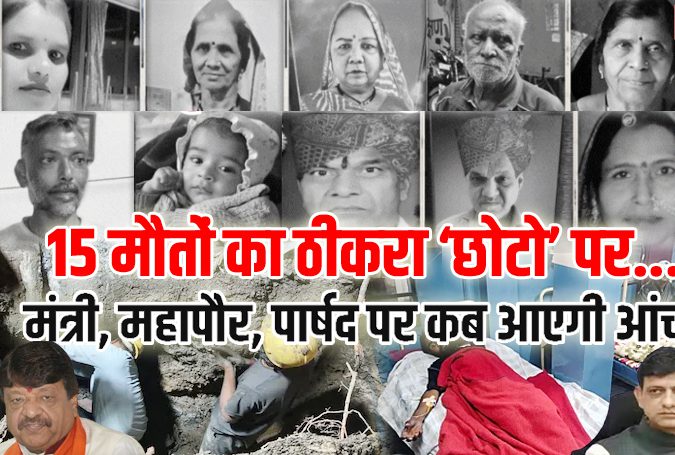
India News : The incident of people falling ill and dying after consuming contaminated drinking water in Indore has triggered massive outrage. According to information from victims’ families and hospitals, 15 people have lost their lives and more than 200 have been hospitalised, while several others are still undergoing treatment. The issue has snowballed into a major administrative, legal, and political controversy.
Taking cognisance of the seriousness of the matter, the state government has constituted a high-level inquiry committee. On the directions of Chief Minister Mohan Yadav, Indore Municipal Corporation Commissioner Dilip Yadav and Additional Commissioner Rohit Sisodia have been issued show-cause notices.
The government has also ordered the immediate removal of Additional Commissioner Rohit Sisodia from Indore and withdrawn the charge of the Water Distribution Department from in-charge Superintending Engineer Sanjeev Shrivastava. However, residents allege that action is being limited to junior officials, while political accountability is being avoided.
Government’s Claim in High Court: Only 4 Deaths
Earlier on Friday, the Madhya Pradesh government submitted its status report before the Madhya Pradesh High Court, claiming that only four deaths were caused by contaminated water. This claim has come under sharp criticism, as families of victims and hospital records indicate 15 deaths so far.
All patients reportedly complained of vomiting, diarrhoea, stomach pain, and fever. The deceased include a five-month-old infant as well as elderly persons.
Dangerous Bacteria Found in Water Samples
Indore CMHO Dr. Madhav Prasad Hasani said that two investigation reports on water quality have been received so far, both confirming that the water was unfit for consumption. Laboratory tests found faecal coliform, E. coli, Vibrio, and protozoa in the samples. Sources claim that Vibrio cholerae, the bacteria responsible for cholera, was also detected, though the administration has termed it a preliminary finding.
Around 80 water samples tested in the municipal laboratory were marked “unsatisfactory”. Samples collected from Bhagirathpura were declared unfit for drinking and domestic use. Officials stated that a leakage in the main drinking water pipeline near a police outpost, with a toilet constructed above it, led to sewage mixing with the water supply.
NHRC Seeks Report, Next Hearing on January 6
The National Human Rights Commission (NHRC) has taken suo motu cognisance of the incident and sought a detailed report from the Chief Secretary within two weeks. The High Court has fixed January 6 as the next date of hearing in the Public Interest Litigation related to the case.
Political Storm Over the Incident
The tragedy has sparked sharp political reactions. Leader of Opposition in Lok Sabha Rahul Gandhi said in a social media post:
“In Indore, poison was distributed instead of water, while the administration remained in deep sleep. Clean water is not a favour—it is a fundamental right.”
Congress president Mallikarjun Kharge criticised both the Centre and the state government, questioning the claims of cleanliness while citizens struggle for safe drinking water.

Former Madhya Pradesh Chief Minister Uma Bharti said the incident was shameful for the state and the system.
“The value of a human life cannot be measured at ₹2 lakh. Those responsible—from top to bottom—must be punished.”
Questions Still Unanswered
Residents are demanding answers to critical questions:
-
Why were repeated complaints of foul-smelling and dirty water ignored?
-
How did sewage mix with the drinking water pipeline?
-
Why was water supply not stopped in time?
-
And when will responsibility be fixed on officials and political leaders?
For now, the Indore water contamination case has become not just an issue of administrative negligence, but a major test of accountability and governance.