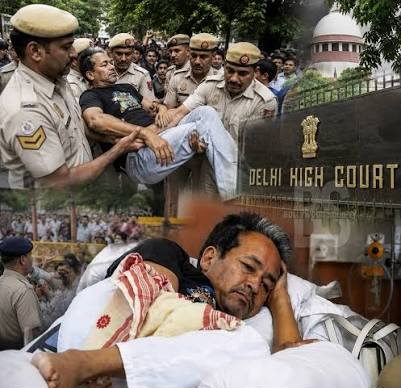
India News : Activist Sonam Wangchuk, who has been on a hunger strike at Delhi’s Jantar Mantar for the past 20 days, was shifted to Safdarjung Hospital by the Delhi Police. Following his transfer, protesters were asked to vacate the demonstration site, while heavy police and paramilitary deployment was seen outside the hospital.
Wangchuk has been on an indefinite fast since June 28, demanding the resignation of Union Education Minister Dharmendra Pradhan over alleged paper leaks and irregularities in major competitive examinations, including NEET.
Hospital Says Wangchuk Is Weak but Stable
Safdarjung Hospital said Wangchuk had become physically weak due to prolonged fasting and dehydration. While his condition is currently stable, doctors said he requires continuous monitoring and medical treatment to restore his health parameters.
The hospital also said Wangchuk has been admitted to the emergency ward. Doctors confirmed that he is conscious and his condition remains stable.
According to the medical team, Wangchuk’s vital signs are generally normal. However, his blood pressure and blood sugar levels are below normal, while his ECG report is normal.
Wife Requests No Treatment Without Consent
Wangchuk’s wife, Geetanjali Angmo, said she was at Safdarjung Hospital and requested that no oral or intravenous treatment be administered without the consent of the family and the doctors who had been monitoring his health over the past 20 days.
Delhi Police Cites Court Directions
Delhi Police said Wangchuk was shifted to the hospital in accordance with court orders and on the advice of medical experts due to his deteriorating health.
The move came after the Delhi High Court heard a public interest litigation concerning Wangchuk’s health and safety. The court directed that government doctors conduct regular medical examinations and that necessary steps be taken based on their reports, observing that every human life is precious.
Earlier, doctors had warned that Wangchuk faced the risk of organ failure if his health did not improve. Despite his declining condition, Wangchuk released a video message on Friday night, stating that he had lost nearly 20 per cent of his body weight and that his muscles had weakened, though his determination and mental strength remained intact.
Doctors at RML Hospital had recommended on July 13 that he be shifted to a hospital for treatment.
Opposition Leaders Criticise the Move
Samajwadi Party MP Dimple Yadav described Wangchuk’s forcible removal as “an assault on democracy and the Constitution.”
Shiv Sena (UBT) leader Aaditya Thackeray wrote on X that the world was witnessing how democracy in India was being undermined and alleged that even peaceful student protests against a Union minister were no longer being tolerated.
Protest Demands
In his video message, Wangchuk appealed to people across the country to participate in the proposed “Chalo Parliament” march on July 20. He argued that if governments could be held accountable over issues such as onion prices, they should also be held accountable for alleged irregularities affecting the education system and the future of millions of students.
He claimed that several students had died by suicide following the NEET controversy and demanded that the government be held accountable.
Wangchuk and the organisations supporting the protest have demanded the resignation of Union Education Minister Dharmendra Pradhan, alleging that irregularities and paper leaks in competitive examinations, including NEET, have eroded public trust. They have also called for an independent probe into the functioning of the National Testing Agency (NTA), a transparent investigation into paper leak cases, and comprehensive reforms in India’s examination system.