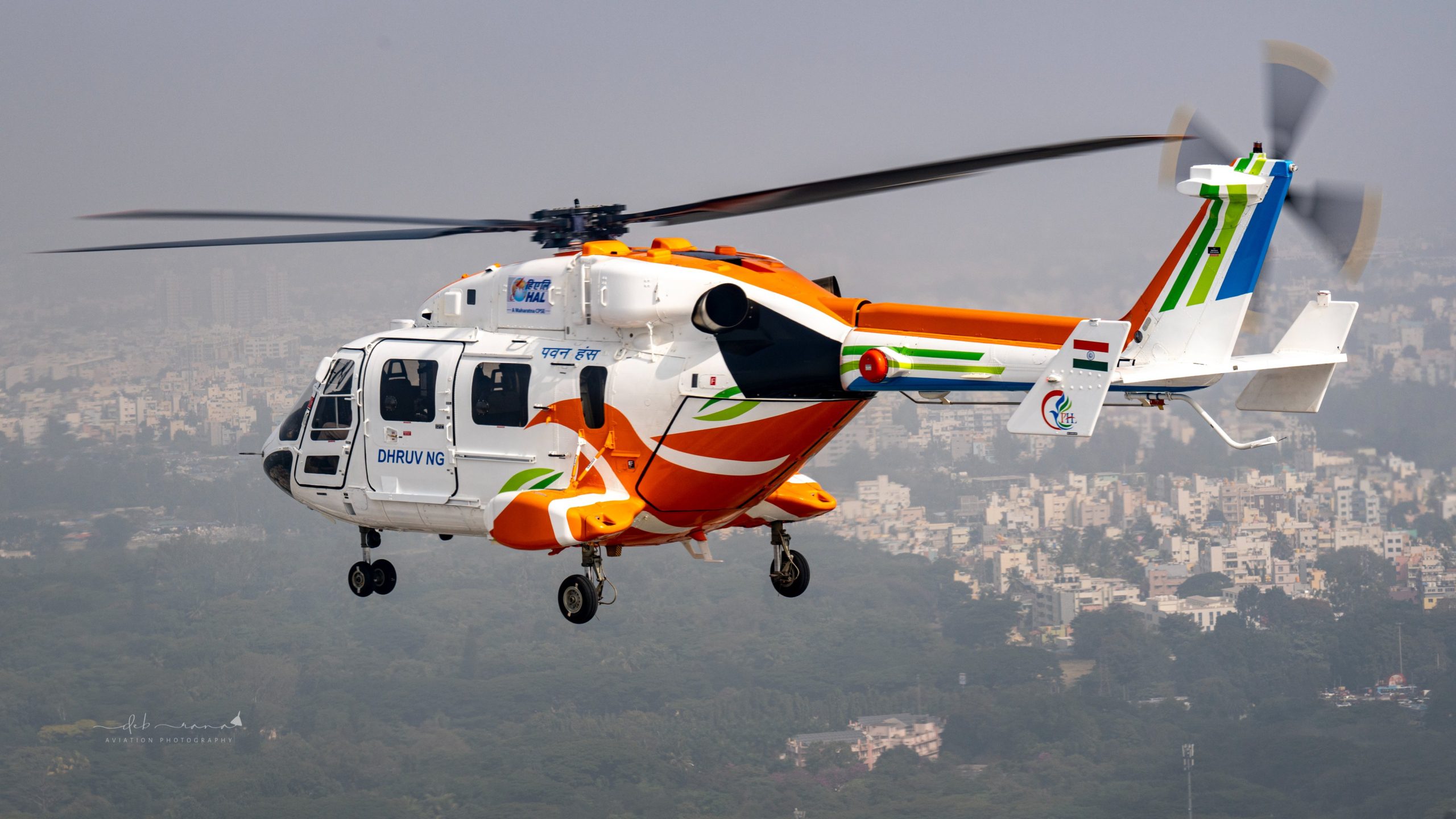
India News : India marked a significant milestone in its aerospace journey as Hindustan Aeronautics Limited (HAL) successfully conducted the maiden flight of its Advanced Light Helicopter Dhruv New Generation (Dhruv NG). The successful first flight strengthens India’s indigenous aviation capabilities and opens new opportunities in the civil and export markets.
Designed and manufactured by HAL, the Dhruv NG is a 5.5-tonne, light, twin-engine, multi-role helicopter developed on the proven Dhruv platform. However, the new-generation variant brings significant upgrades in safety, performance, ease of flying, and passenger comfort, while retaining excellent high-altitude and hot-weather operational capability suited to Indian conditions.
Indigenous Power and Advanced Systems
At the core of the Dhruv NG are two fully indigenous Shakti 1H1C engines. These engines deliver higher power output while ensuring domestic maintenance and long-term support. HAL stated that the use of Shakti engines enhances self-reliance and reduces lifecycle costs for civil operators.
The helicopter features a civil-certified glass cockpit compliant with AS4 standards, equipped with modern avionics and navigation systems. These systems provide enhanced situational awareness for pilots and significantly reduce workload, making operations safer and more efficient.
Enhanced Safety and Passenger Comfort
The Dhruv NG is designed to safely carry civilian passengers and incorporates multiple advanced safety features, including crashworthy seats, self-sealing fuel tanks, and a twin-engine configuration. Special emphasis has been placed on ride comfort through advanced vibration control systems, making it ideal for VIP transport and emergency medical services.

Performance and Versatility
The helicopter has a maximum take-off weight of 5,500 kg, a top speed of approximately 285 kmph, and a range of about 630 km with a 20-minute reserve. It can remain airborne for up to 3 hours and 40 minutes and operate at altitudes of up to 6,000 metres. The internal payload capacity is around 1,000 kg.
With a cabin volume of 7.33 cubic metres, the Dhruv NG can be quickly reconfigured for multiple civil roles. It can accommodate 4–6 passengers in VIP/VVIP layout, up to 14 passengers in commuter configuration, or serve as an air ambulance with space for four stretchers, a doctor, and a medical attendant.
The successful maiden flight of the Dhruv NG marks a major step forward for India’s indigenous helicopter programme and reinforces HAL’s position as a key player in the global rotorcraft market.