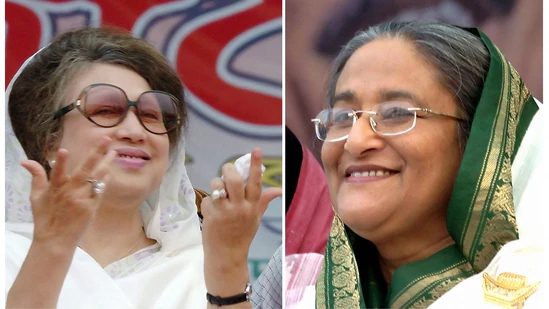
India News : Former Bangladesh Prime Minister Khaleda Zia passed away at the age of 80, marking the end of a significant chapter in Bangladesh’s political history. Often regarded as less friendly towards India compared to her long-time rival Sheikh Hasina, Khaleda Zia nevertheless shared a deep and personal connection with India that few are aware of.
Khaleda Zia was born in 1945 in Jalpaiguri, which at the time was part of undivided Bengal. Before India’s Partition in 1947, Jalpaiguri fell under the Dinajpur region, when India, Pakistan, and present-day Bangladesh were still one entity. Following Partition, West Bengal became part of India, while East Bengal went to Pakistan and later emerged as Bangladesh after the Liberation War on December 16, 1971.
As a result of these historic changes, Khaleda Zia lived her life as a citizen of three nations — British India, Pakistan, and finally Bangladesh. She went on to make history as Bangladesh’s first woman Prime Minister and one of South Asia’s most influential political figures. Her family relocated to Dinajpur after Partition, where she completed her schooling at a missionary institution and later studied at a girls’ college.
Entry into Politics After Husband’s Assassination
Khaleda Zia’s political journey gained momentum after the assassination of her husband, Ziaur Rahman, who was serving as President of Bangladesh when he was killed during a military coup in 1981. The country subsequently remained under military rule for nearly nine years.
During this turbulent period, Khaleda Zia emerged as a strong opposition voice. She actively challenged the military regime led by Hussain Muhammad Ershad and formed a seven-party alliance to restore democracy. Between 1983 and 1990, she was detained seven times but remained steadfast in her opposition, even boycotting the 1986 elections.

Prime Ministerial Tenure and Controversies
In 1991, Khaleda Zia assumed office as Prime Minister, ushering in a return to parliamentary democracy in Bangladesh. Her government also introduced the caretaker government system to ensure free and fair elections. She served three terms as Prime Minister after 1991, playing a decisive role in shaping the country’s democratic framework.
However, her tenure from 2001 to 2006 was marred by political controversies and allegations of corruption. Her son Tarique Rahman also remained in the spotlight for controversial reasons. After 17 years in exile, Tarique Rahman recently returned to Bangladesh amid massive public support and is now being viewed by many as a potential future Prime Minister under changing political circumstances.
Despite criticism and political rivalry, Khaleda Zia remains one of the most influential leaders in Bangladesh’s history — a woman who rose from personal tragedy to national leadership, navigating a complex political landscape shaped by military rule, democracy, and regional geopolitics.