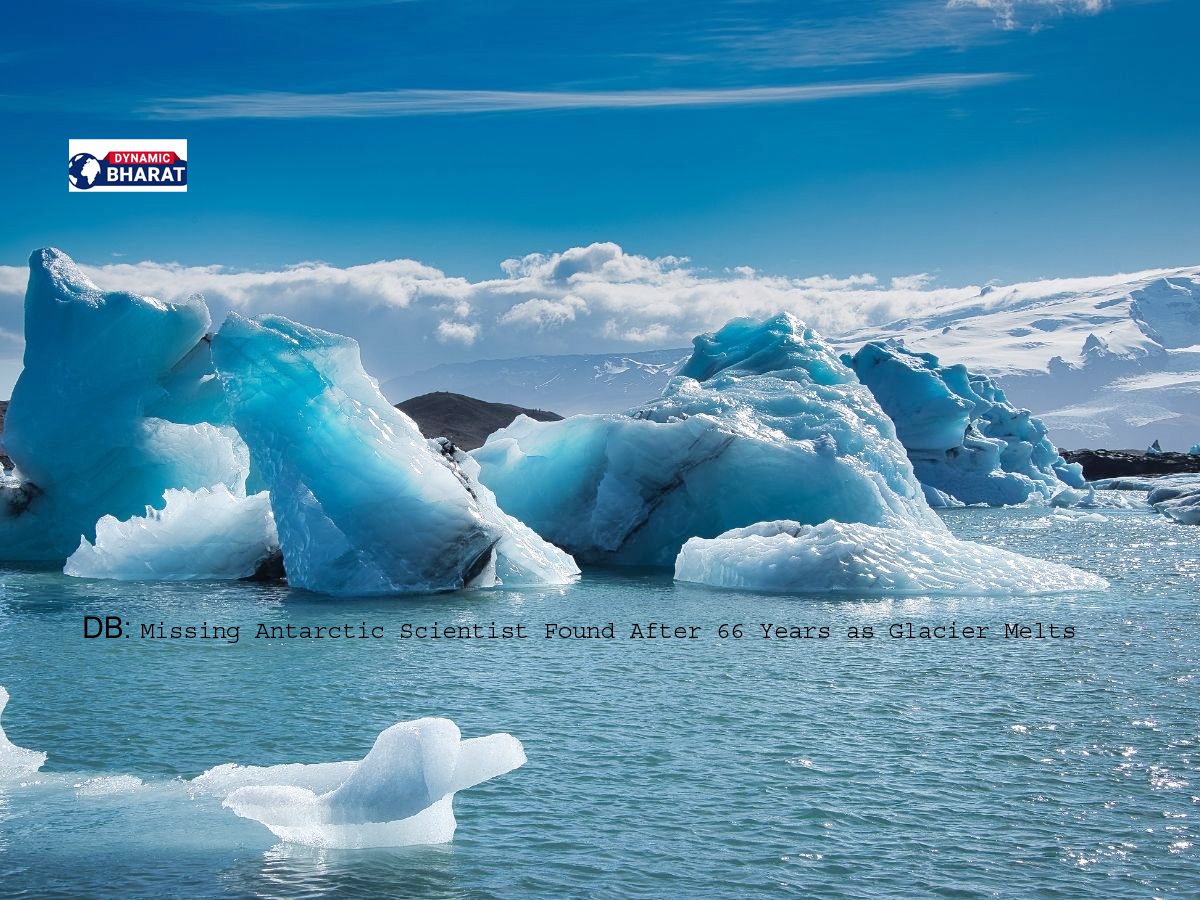
More News : The decades-old mystery of a missing British meteorologist has finally been solved after 66 years, thanks to melting Antarctic ice. In January 2025, a Polish Antarctic expedition discovered human remains alongside more than 200 personal belongings — including a wristwatch, Swedish knife, radio equipment, and ski poles — near Ecology Glacier on King George Island. DNA testing confirmed the remains belonged to Dennis “Tink” Bell, a 25-year-old scientist who vanished in 1959.
Bell was working for the Falkland Islands Dependencies Survey (now the British Antarctic Survey) when he disappeared on July 26, 1959. He was conducting research on a glacier in Admiralty Bay with colleague Jeff Stokes as part of a dog-sled survey mission. According to accounts, Bell, eager to encourage their tired husky dogs, walked ahead without wearing skis. Tragically, he fell into a deep crevasse.
Stokes attempted a desperate rescue, lowering a belt to pull Bell up. However, the belt snapped, sending Bell further into the icy depths. After that, there was only silence. A search operation was launched but ended without success, and Bell’s body was never recovered — until now.
Bell’s brother, David Bell, now 86, expressed his shock and relief at the discovery. “I had given up hope of finding my brother. This is a miracle; I still can’t believe it,” he said.
The discovery was made possible due to the accelerating effects of climate change. Antarctica’s glaciers, including the Ecology Glacier, are melting at unprecedented rates, exposing long-buried relics and remains. British Antarctic Survey Director Jane Francis described the find as “a final closure to a decades-old mystery” and a poignant reminder of the human stories embedded in the history of Antarctic science.

The find also highlights a broader trend in polar regions — as ice sheets and glaciers retreat, they are revealing preserved evidence of past expeditions, lost explorers, and even aircraft wreckage. While these discoveries bring long-awaited answers to families, they also serve as stark evidence of the planet’s changing climate.
For the scientific community, Bell’s story stands as a testament to the dangers faced by early Antarctic explorers and the dedication with which they pursued their research. The recovery of his remains, though bittersweet, ensures that his contribution to polar science will not be forgotten.