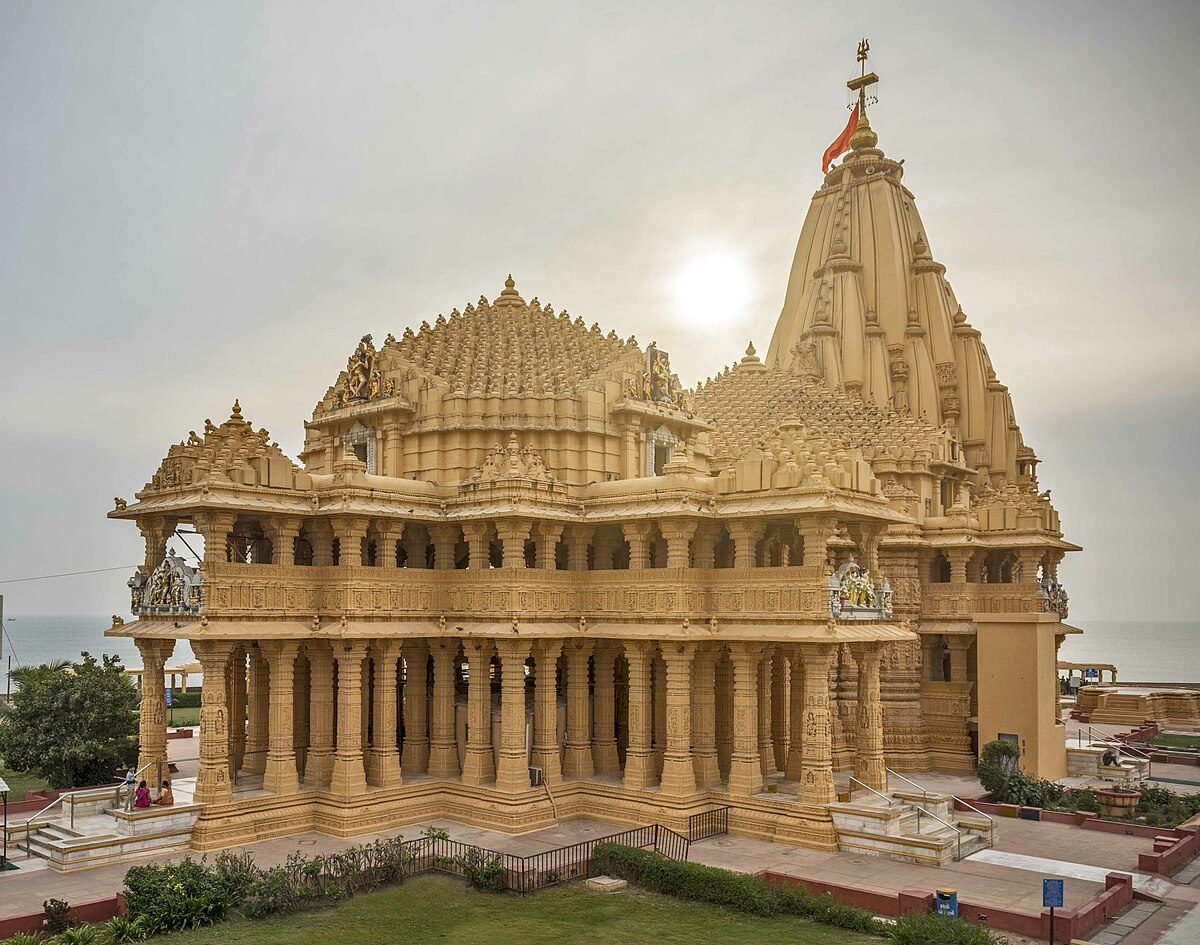
India News : The Somnath Temple is not merely a religious monument built of stone—it stands as a powerful symbol of India’s ancient civilisation, cultural continuity, and spiritual resilience. Over centuries, the temple has witnessed repeated invasions, destruction, and rebuilding, yet it has never lost its identity or significance.
The year 2026 holds special historical importance for Somnath. It marks 1,000 years since the first major invasion in 1026 CE, when the temple was attacked by Mahmud of Ghazni. At the same time, it also commemorates the 75th anniversary (Platinum Jubilee) of the consecration of the modern Somnath Temple in 1951. Together, these milestones reflect a thousand-year journey from destruction to revival—an enduring testimony to India’s civilisational strength.
⚔️ A Millennium of Destruction and Revival
Renowned historian and freedom fighter K. M. Munshi, in his book Somnath: The Shrine Eternal, described the temple as being as ancient as creation itself. Historical accounts note that Mahmud of Ghazni attacked Somnath on January 6, 1026, after an arduous campaign. It is believed that nearly 50,000 people were killed while defending the shrine.
Subsequently, the temple faced repeated assaults—by Alauddin Khilji’s general Alaf Khan in 1299, by Muzaffar Khan in 1394, Mahmud Begada in 1459, and later by Mughal emperor Aurangzeb, who ordered its demolition in 1669 and again in 1702. Despite this, devotion to Somnath never faded.
📜 Al-Biruni’s Historical Testimony
The 11th-century Persian scholar Al-Biruni, who accompanied Mahmud of Ghazni to India, documented these events in his work Kitab-ul-Hind. He wrote that Somnath was not just a temple but a major cultural, intellectual, and economic centre, attracting scholars, artists, traders, and pilgrims from across regions.
Al-Biruni also observed that Somnath played a crucial role in maritime trade, linking India with Africa and China, making it one of the most prosperous centres of its time.

🌿 Revival in Modern India
In 1783, Ahilyabai Holkar constructed a new shrine nearby to preserve the sanctity of the Jyotirlinga. After India’s independence, Sardar Vallabhbhai Patel announced the reconstruction of the Somnath Temple on November 13, 1947, viewing it as a matter of national self-respect rather than religious politics.
The rebuilt temple was inaugurated in 1951 by India’s first President, Dr. Rajendra Prasad, who stated that honoring one’s cultural heritage is not contrary to secularism, but an expression of national pride.
Earlier, in the 1890s, Swami Vivekananda had visited Somnath and remarked that such temples explain Indian history far more deeply than books—structures that were destroyed a hundred times and rebuilt a hundred times.
🌅 A Living Message
Today, the Somnath Temple stands not just as a place of worship but as a living message—that civilizations rooted in faith, confidence, and cultural consciousness cannot be erased by force. Somnath remains a timeless inspiration, reflecting India’s past, present, and enduring future.