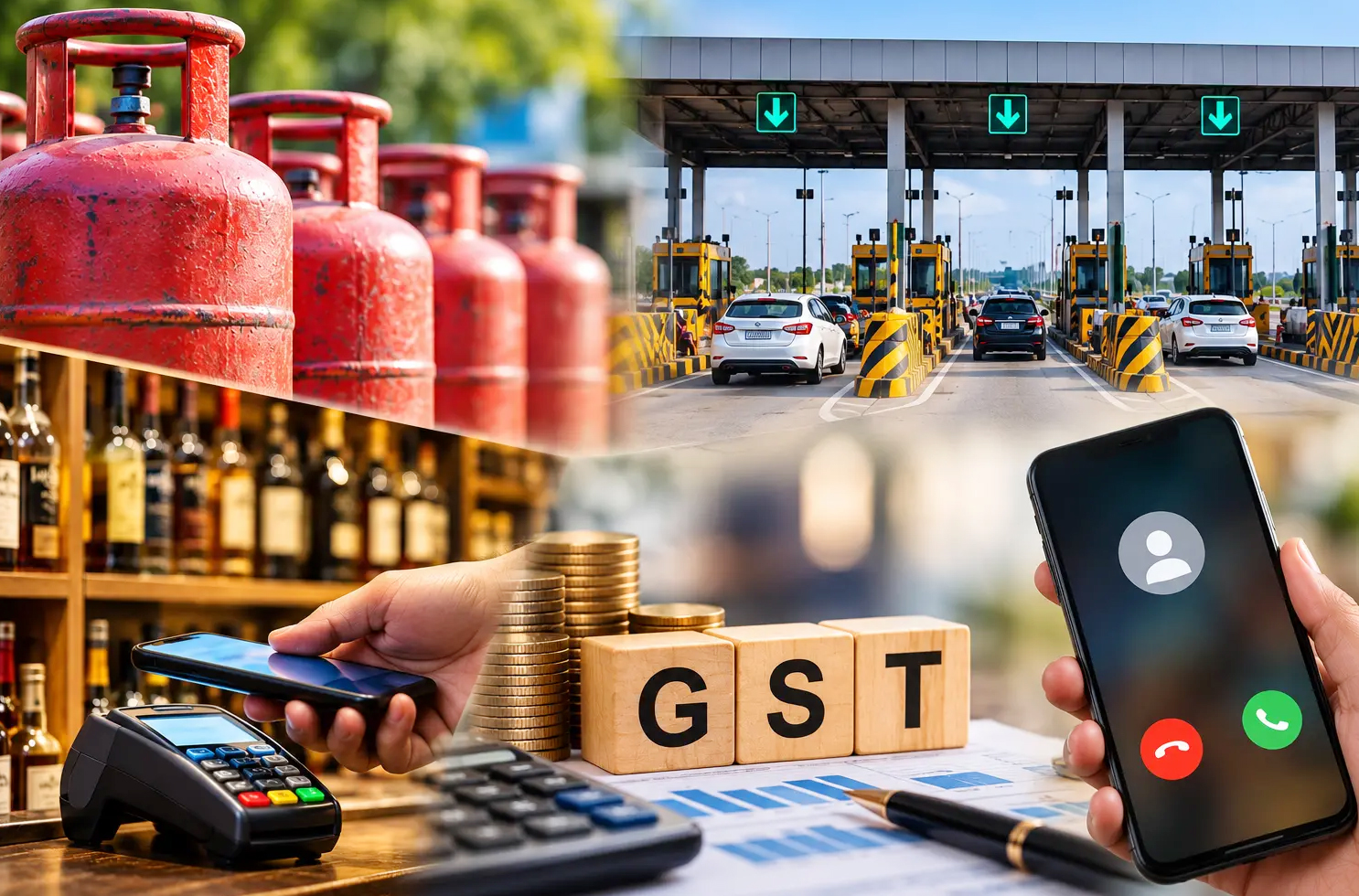
New Delhi : The beginning of November has brought several important changes in rules and services across India. These changes will affect vehicle owners, mobile phone users, businesses, pensioners, bank customers and railway passengers.
From a new concessional toll pass for residents living near National Highway toll plazas to caller name display on mobile phones, changes in GST provisions, vehicle restrictions in Delhi and digital payment rules in Tamil Nadu, several new measures have come into effect from today.
A new Digital Life Certificate campaign for pensioners has also begun, while the Bengaluru-Mumbai Vande Bharat Sleeper Express is scheduled to operate its inaugural special service today.
Here are nine major updates and how they may affect you.
1. New Annual Toll Pass for Residents Living Near Toll Plazas
The Central Government has introduced a new Concessional Local Pass for eligible non-commercial vehicle owners living within 20 kilometres of a National Highway toll plaza. The facility has come into effect from November 1, 2026.
The annual charges will depend on the location of the toll plaza:
- ₹1,500 per year for toll plazas located outside municipal or local town limits.
- ₹3,000 per year for toll plazas situated within municipal or local town limits.
Eligible vehicle owners must have a valid and functional FASTag. The pass will be valid only at the specific toll plaza for which it is issued and cannot be transferred to another plaza.
The facility will not be available on highways or expressways operating under a closed user-fee collection system. It will also not be issued where a service road or alternative route is available.
The pass will be available at eligible toll plazas from November 1, while the facility through the Rajmargyatra app will begin on December 1, 2026.
2. Delhi Restricts Entry of Older Vehicles Registered Outside the Capital
Delhi has introduced vehicle restrictions as part of its winter pollution-control measures.
From November 1, non-Delhi-registered petrol and diesel vehicles that do not meet BS-VI emission standards will be prohibited from entering the national capital. The restriction will remain in force until January 31, 2027.
CNG and electric vehicles are exempt from this restriction, along with specified emergency and essential-service vehicles.
The measure is part of Delhi’s winter pollution-control plan, aimed at reducing vehicle emissions during the period when air quality generally deteriorates.
Motorists travelling to Delhi should check their vehicle’s emission category and ensure that their Pollution Under Control (PUC) certificate is valid.
3. Goods Vehicles Banned on Mumbai-Pune Expressway’s Missing Link
New traffic restrictions have come into effect on the connecting link, also known as the Missing Link, of the Mumbai-Pune Expressway.
From November 1, the Maharashtra Highway Police has prohibited all goods-carrying vehicles from using this section. The restriction includes small commercial vehicles, pickup vans and Tata Ace vehicles.
Vehicles carrying inflammable, explosive and other hazardous materials will also be prohibited from using the route. Such vehicles will have to continue using the original Mumbai-Pune Expressway alignment.
Under the revised rules:
- Private cars and other eligible light motor vehicles can travel at a maximum speed of 100 kmph.
- Passenger buses and other passenger vehicles can travel at a maximum speed of 80 kmph.
- All goods vehicles must use the existing expressway route.
The restrictions have been introduced keeping in view the design and technical features of the connecting link’s tunnels and commuter safety. They will remain in force until further orders.
4. GST Rules Change: New Provisions on Discounts and Refunds
Several amendments to the Goods and Services Tax (GST) framework have come into effect from November 1.
Through Notification No. 03/2026-Central Tax, dated October 26, 2026, the Central Government has brought Sections 153 to 155 of the Finance Act, 2026, into force.
The amendments relate to Sections 15, 34 and 54 of the Central Goods and Services Tax Act, 2017.
Post-supply discounts: Businesses can now exclude qualifying discounts offered after the supply of goods or services from the taxable value, provided the supplier issues a credit note and the recipient reverses the corresponding input tax credit (ITC).
Credit notes: The provisions have been amended to specifically recognise credit notes issued for such post-supply discounts.
GST refunds: The changes extend provisional refund provisions to eligible unutilised ITC arising under the inverted duty structure. They also modify the treatment of certain refund claims relating to exports of goods made with payment of tax.
These amendments are intended to provide greater clarity and flexibility in GST compliance for eligible businesses.
However, reports about automatic refunds and a simplified annual return system for businesses with turnover below ₹5 crore should not be confused with these specific amendments. Those proposals have separate implementation requirements and should not be treated as automatically applicable to every business from November 1.
5. CNAP Service to Display Names of Unknown Callers
Mobile phone users will begin receiving a new caller identification facility called Calling Name Presentation (CNAP) from November 1.
The Department of Telecommunications (DoT) has directed telecom service providers to introduce the service across their service areas.
Under the new system, incoming calls will display the caller’s phone number along with the name associated with the subscriber’s telecom records.
Key features include:
- The name saved in the recipient’s contact list will continue to take priority.
- For an unsaved domestic number, the name registered with the telecom operator will be displayed.
- International calls will be identified with the label “International Call”.
- Users will not need to make a separate request to activate the service.
- Names of subscribers using Calling Line Identification Restriction (CLIR) will not be displayed.
The initial rollout covers wireless networks using 4G and higher-generation technologies. The introduction of CNAP on 2G and 3G networks and landline connections will be considered separately.
The government hopes the service will improve caller identification and help users identify suspicious calls. However, it should not be considered a complete solution to cyber fraud.
6. Digital Payments Mandatory for Liquor Purchases Above ₹1,000 in Tamil Nadu
The Tamil Nadu State Marketing Corporation (TASMAC) has introduced a new payment rule for retail liquor purchases.

From November 1, digital payment has become mandatory for liquor bills exceeding ₹1,000 at TASMAC retail outlets across the state.
Customers making purchases above this amount will have to pay through digital methods such as:
- UPI
- Debit cards
- Credit cards
According to the company’s instructions, payments will be processed through point-of-sale (POS) machines linked to its designated bank account.
The payment threshold will be reduced further to ₹500 from January 1, 2027.
The measure aims to reduce cash handling, improve transparency and minimise discrepancies in retail transactions.
7. Pensioners Can Submit Life Certificates From November 1
Pensioners who receive government pensions can submit their annual Life Certificate, also known as a Jeevan Pramaan Patra, from November 1 to November 30, 2026.
For pensioners aged 80 years and above, the submission window began earlier, on October 1.
The Department of Pension and Pensioners’ Welfare has also launched the Fifth Nationwide Digital Life Certificate Campaign from November 1 to 30.
Under this campaign:
- Camps will be organised in 2,000 cities and districts across India.
- Face Authentication Technology will receive special attention.
- Banks, post offices, pensioners’ associations, UIDAI and other government agencies will participate.
- The campaign aims to make digital life certificate submission easier, particularly for elderly pensioners.
The initiative is intended to help pensioners submit their certificates without unnecessary travel or lengthy procedures.
8. Bank Branches to Remain Closed on Several Days in November
Bank customers should check the Reserve Bank of India’s (RBI) state-wise holiday calendar before visiting a branch during November.
Festival-related holidays will result in bank closures on different dates across different states.
The major regional holiday dates include:
November 9, 10, 11, 13, 16, 20, 23, 24 and 27.
These holidays are linked to occasions such as Diwali, Govardhan Puja, Wangala Festival, Chhath Puja, Igas-Bagwal, Seng Kut Snem, Guru Nanak Jayanti and Kanakadasa Jayanti.
Some important state-specific closures include:
- November 16: Banks in Bihar and Jharkhand will remain closed for Chhath Puja.
- November 24: Banks will remain closed in several states, including West Bengal, Jharkhand, Delhi, Uttar Pradesh, Maharashtra and Chhattisgarh, for Guru Nanak Jayanti and Kartika Purnima.
In addition to festival holidays, banks will remain closed on all Sundays—November 1, 8, 15, 22 and 29—and on the second and fourth Saturdays, November 14 and 28.
These festival holidays are not applicable uniformly across the country. Customers should check the holiday schedule for their respective state.
Digital banking services, including UPI, mobile banking, internet banking and ATM services, are generally available during branch holidays.
9. Bengaluru-Mumbai Vande Bharat Sleeper Inaugural Service Today
Railway passengers will also get a new overnight travel option between Bengaluru and Mumbai with the launch of the Vande Bharat Sleeper Express.
The inaugural one-way special service, Train No. 06503, is scheduled to depart Sir M. Visvesvaraya Terminal (SMVT), Bengaluru, at 12:15 pm on November 1.
It is scheduled to reach Chhatrapati Shivaji Maharaj Terminus (CSMT), Mumbai, at 6:15 am on November 2.
The train will have 16 coaches and will stop at several stations, including Hindupur, Dharmavaram, Anantapur, Guntakal, Raichur, Krishna, Yadgir, Kalaburagi, Solapur, Pune, Lonavala and Kalyan during the inaugural journey.
Regular services will begin on different dates in the two directions:
- Mumbai to Bengaluru: November 2, 2026.
- Bengaluru to Mumbai: November 3, 2026.
The regular services will operate six days a week. The Bengaluru-Mumbai service will not operate on Mondays, while the Mumbai-Bengaluru service will remain suspended on Tuesdays.
The new service is expected to provide passengers with an overnight rail travel option between Karnataka and Maharashtra.
How Will These Changes Affect You?
The changes introduced from November 1 cover several aspects of everyday life.
Local residents living near National Highway toll plazas may benefit from the concessional annual pass. Vehicle owners travelling to Delhi must check the BS-VI restrictions, while commercial vehicle operators using the Mumbai-Pune Expressway must follow the revised route rules.
Mobile users will receive the CNAP caller identification facility on supported networks. Eligible businesses will need to take note of the revised GST provisions, while pensioners should complete their Life Certificate submission within the prescribed period.
Bank customers must check state-specific holiday schedules, and railway passengers can look forward to the new Bengaluru-Mumbai Vande Bharat Sleeper service.
Importantly, not all these changes apply uniformly across India. Some are nationwide provisions, while others are restricted to particular states, cities, highways or eligible users. Checking the relevant department’s official notification before making travel or financial decisions is advisable.