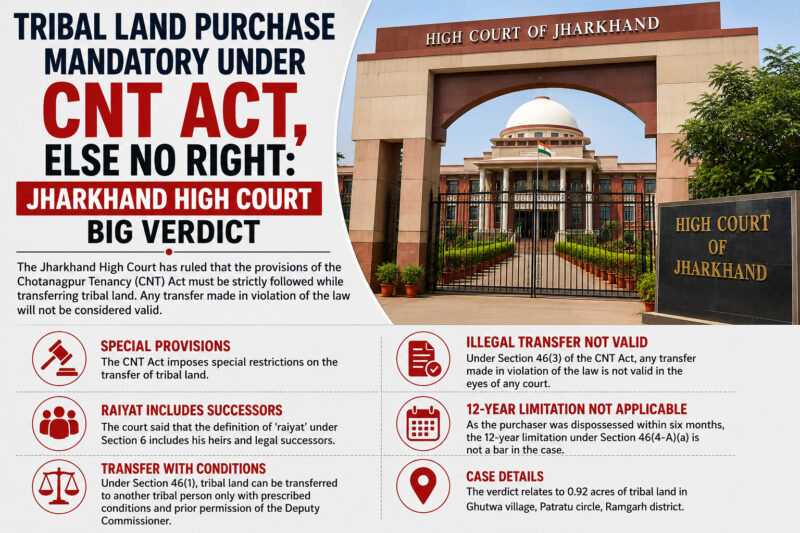
Jharkhand News : The Jharkhand High Court has dismissed a petition concerning tribal land in the Patratu circle of Ramgarh district. Justice Sanjay Kumar Dwivedi’s court observed that the Chotanagpur Tenancy Act (CNT Act) imposes specific restrictions on the transfer of tribal land and that any transfer made in violation of the law cannot be treated as valid.
The court upheld the order of the revision authority and dismissed the petition. The case relates to 0.92 acres of land under Khata No. 42 and Plot No. 1273 in Ghutwa village of Ramgarh.
What Is the Land Dispute About?
According to the petitioners, Sadik Mian had purchased the land through a registered sale deed in 1970 and had remained in possession since then. An application was later filed for mutation of the land, but the mutation could not be completed.
The other party claimed to have purchased 0.67 acres of the same plot in 2003. Permission for the purchase had been obtained from the then Deputy Commissioner, following which the land was mutated in that person’s name.
The party claimed that they were dispossessed from the land within six months of purchasing it. They subsequently filed an application for restoration of the land under Section 46(4-A) of the CNT Act.
What Did the Court Say About the Bedia Community?
The petitioners opposed the claim, arguing that the land was tribal land and that the claim by the other party was filed beyond the prescribed limitation period. They also argued that the Bedia community was not included in the Scheduled Tribe list.
The court rejected this argument. Referring to the Constitution (Scheduled Tribes) Order notification dated September 6, 1950, the court observed that Bedia was included in the Scheduled Tribe list issued for Bihar.

Court’s Observation on Section 46 of CNT Act
The court referred to Section 6 of the CNT Act and observed that the definition of a raiyat also includes their successors. It also noted that permission had been obtained from the Deputy Commissioner for the 2003 land purchase and that mutation was subsequently carried out in the name of the concerned party.
The court said that under Section 46(1) of the CNT Act, land belonging to a Scheduled Tribe raiyat can be transferred to another Scheduled Tribe person only subject to the prescribed conditions and with the prior permission of the Deputy Commissioner.
Illegal Transfer Cannot Be Treated as Valid
The court observed that under Section 46(3), a transfer made in violation of the law cannot be recognised as valid by any court.
The court also accepted that the party who purchased the land in 2003 had been dispossessed within six months. Therefore, the 12-year limitation period prescribed under Section 46(4-A)(a) of the CNT Act did not operate as a bar in the case.